

- A nineteen-year-old spray paints a eulogy across SoHo buildings. SAMO© IS DEAD.
Jean-Michel Basquiat had just killed his graffiti persona. The cryptic street poems that made downtown Manhattan take notice, the sardonic slogans signed with a copyright symbol, the anonymous provocations that earned coverage in the Village Voice: erased by three words on a wall.
Two years later, his first American solo show at Annina Nosei Gallery. Within months, Documenta 7 in Kassel, the youngest artist ever exhibited. By twenty-two, the Whitney Biennial, collaborations with Warhol, paintings selling for tens of thousands.
The art world called it meteoric. They missed the architecture underneath.
Basquiat painted constantly. In 1982 alone, he produced roughly 200 canvases. He showed up at every opening, every party, every gathering where artists congregated. He wore painted clothes, carried his portfolio, talked to everyone. He sold hand-painted postcards on the street. He appeared on public access television. He infiltrated gallery openings before anyone knew his name. He transformed himself from street to gallery by expanding what would later be called Luck Surface Area.
The Why
Luck Surface Area measures your exposure to random opportunity.
Jason Roberts coined the term in a 2010 blog post while co-hosting a podcast about startups and software. Equally talented entrepreneurs kept diverging: some attracted opportunities that others never encountered. His explanation took the shape of a formula: L = D × T. Luck equals Doing multiplied by Telling. The more you create, the more potential connection points you generate. The more people who know about them, the more vectors opportunity can travel.
Do things. Tell people.
Traditional luck thinking positioned opportunity as lightning striking across a flat plain. You stood there. You hoped. Luck Surface Area reconfigured the geometry. You could build towers, construct antennas, raise your vertical profile. Lightning still struck at random. You changed how much of yourself was exposed to the sky.
Every project created a potential connection node. Every conversation multiplied those nodes by the number of people who heard. A creator making one thing per year and telling ten people generated ten possible vectors. A creator making fifty things and telling a thousand people generated fifty thousand. The relationship is multiplicative: double either variable and you double the total surface area.
Creatives resisted this model. It smelled like hustle culture, like commodifying art, like betraying some pure creative ideal. That resistance cost them years. Gallery owners discovered artists they heard about. Publishers acquired books they knew existed. Producers funded films they'd seen samples of. Opportunity required awareness. Awareness required exposure. Exposure required deliberate expansion of surface area.
The How
Expanding your Luck Surface Area requires systematic action across both variables in the formula: doing and telling.
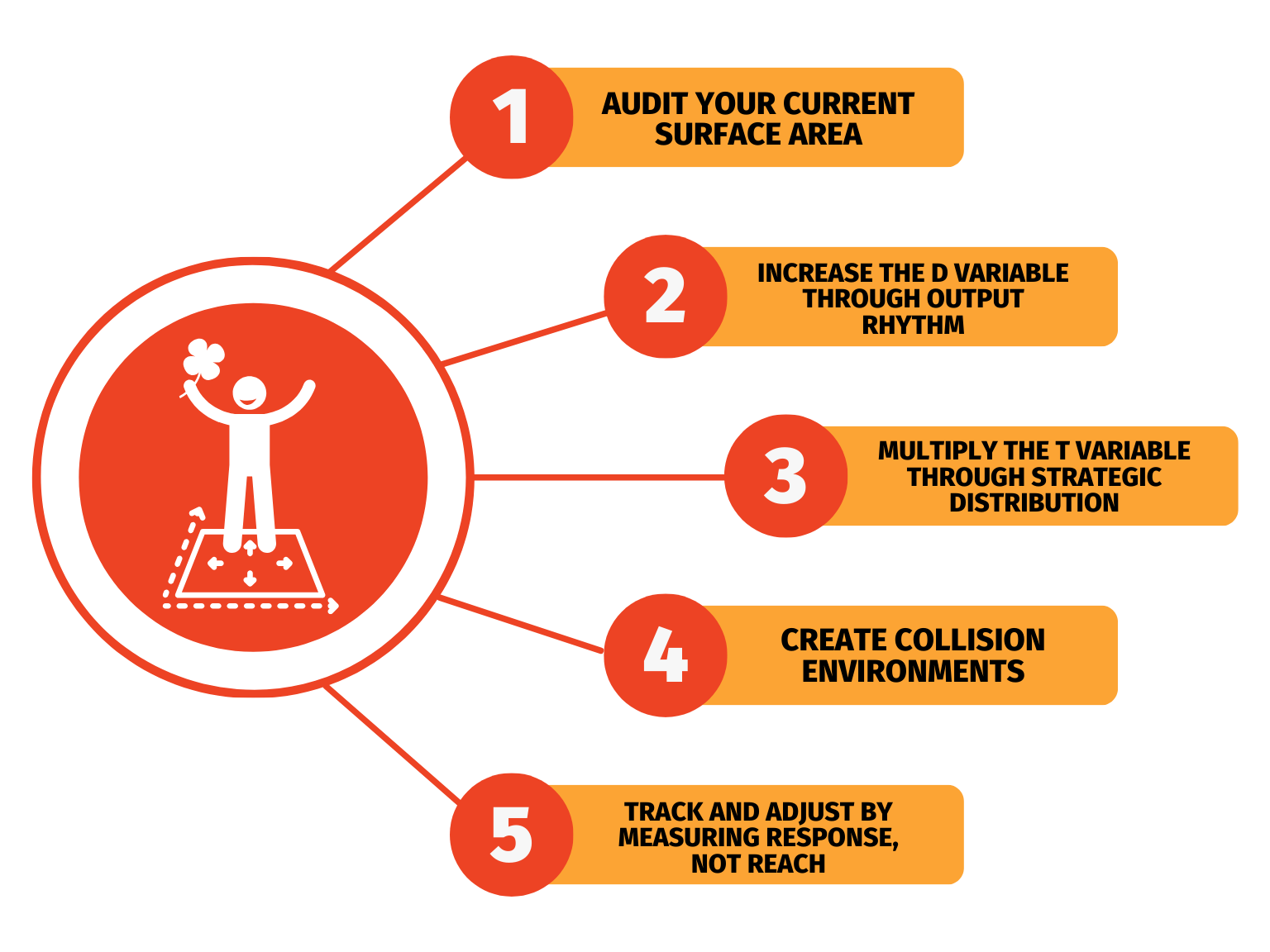
- Audit your current surface area. Draw two columns. Left column: everything you created in the past twelve months. Right column: every person or platform that saw it. Count the total in each column. Multiply them. That number is a rough approximation of your current Luck Surface Area. Basquiat's 1982 audit would have shown roughly 200 canvases on the left, and thousands of gallery visitors, television viewers, and street encounters on the right. A photographer who shot 300 images last year but posted twelve to a private Instagram account with 40 followers has a surface area of 480. The same photographer sharing those twelve across three platforms reaching 2,000 people has a surface area of 24,000. Same work. Fifty times the exposure. Most creatives discover a lopsided picture: heavy creation, almost no distribution. Or heavy broadcasting, almost nothing worth broadcasting. The audit reveals which variable is starving.
- Increase the D variable through output rhythm. Set a quota you can sustain for twelve months. One finished piece per week. Five sketches per day. Three prototypes per month. The specific number matters less than the consistency. Each completed piece adds a node to your surface area that persists long after you've moved on. A story published in an obscure journal in 2019 can generate an email from a producer in 2025. The node stays active. The surface area accumulates.
- Multiply the T variable through strategic distribution. One platform creates one layer of exposure. The same piece shared across five platforms creates five layers, each reaching different clusters of people. Your ideal collaborator may scan LinkedIn and never open Instagram. Your next collector may browse Reddit and ignore Twitter. Basquiat sold postcards on the street, appeared on TV, crashed gallery openings, and painted in public. Each channel reached a different set of eyes. Coverage first. Depth follows, once you've identified which channels produce real connections.
- Create collision environments. Show up in rooms where gatekeepers, collaborators, and audiences gather in the same space. Basquiat infiltrated gallery openings. Hemingway haunted the cafés of Montparnasse, where publishers, editors, and fellow writers drank at adjacent tables. The digital equivalent exists for every discipline: conferences, workshops, online communities where decision-makers participate alongside emerging creators. A single evening in the right room generates more surface area than a month of broadcasting into the void.
- Track and adjust by measuring response, not reach. Surface area without feedback loops wastes information. Note which pieces generate conversations, which platforms produce real connections, which environments yield collaborators. Double down on working variables. Abandon channels that produce impressions without interaction. Impressions are phantom surface area.
Mistakes to Avoid
- Expanding only one variable. The formula is multiplicative. A thousand pieces of work seen by nobody produces zero surface area. A massive social following with nothing original behind it produces zero surface area. Both variables must grow. The creator who writes fifty stories and tells nobody generates the same luck as the creator who tells fifty thousand people about the story she never finishes.
- Confusing phantom surface area with real surface area. Follower counts, page views, and impression metrics measure potential reach. Luck Surface Area measures the actual intersection of your work and another person's awareness. A thousand passive followers create less real surface area than ten people who have read your work closely enough to remember it when opportunity appears. Optimize for the ten.
- Sporadic expansion followed by collapse. Surface area decays without maintenance. Disappearing for three months collapses your presence in every channel. The gallery owner who remembered your name in January has forgotten it by April. Regular output at a sustainable pace accumulates more surface area across a year than a burst of activity followed by six months of silence.
- Perfecting instead of shipping. Work locked in revision generates zero surface area. The painting in the studio, the manuscript in the drawer, the demo on the hard drive: invisible to every possible connection point. A finished piece distributed at 80% polish creates more surface area than a perfect piece stored where nobody can find it.
The Rejection Equation
Stephen King collected rejection slips on a nail in his wall. By the time he turned fourteen, the nail buckled under the weight. He replaced it with a spike and kept writing. Years later, living in a double-wide trailer in Maine, teaching high school English to pay the bills, he was still collecting them.
Carrie sold after 30 rejections. The paperback rights went for $400,000.
Most creators track acceptances as their measure of expanding Luck Surface Area. They are tracking the wrong variable.
Every rejection is a contact point. An agent who says no still registers your name. An editor who passes still read your work. A gallery that declines still catalogued your submission. You entered their system. When timing shifts, when their needs change, when their roster opens, you are already filed. The agent who rejected your first novel still has your name on file when she needs exactly your kind of voice eighteen months later. That file exists because you submitted, not because you succeeded.
Rejections create more surface area than acceptances. An acceptance closes one pathway. A rejection leaves it dormant, potentially reactivable, while freeing you to generate ten more contact points elsewhere. The formula does not distinguish between positive and negative interactions. A no is still a data point in someone's memory.
Track your rejection rate the way a scientist tracks experimental trials. Low rejection rates signal insufficient surface area. You are not reaching enough decision-makers. You are not submitting to enough venues. Your exposure remains contained within comfortable boundaries.
Aim for fifty rejections per quarter. Query a hundred agents. Submit to two hundred publications. Apply to a hundred and fifty opportunities. Each no expands your network. Each pass plants your name. Each decline proves you are operating at the scale the formula requires.
Basquiat died at twenty-seven. In eight years of serious work, he created over 600 paintings and 1,500 drawings. He collaborated with Warhol. He showed globally.
His talent filled one side of the equation. His relentless expansion of visibility filled the other. Two hundred canvases in a single year, and every person in downtown Manhattan who cared about art knew where to find them.
The formula is indifferent to when lightning strikes. It governs how tall the antenna stands when the storm arrives.