
Oren Jacob watched the files vanish. He stood in Larry Cutler's office at Pixar's Richmond, California campus in 1998, staring at a directory for the character Woody on his screen. Forty files. He refreshed. Four files. Sequences dissolved while he watched. Someone had entered a Unix command on the root folder of the Toy Story 2 assets: /bin/rm -r -f *. The command did what commands do. It erased everything.
Within minutes, 90% of the film had disappeared. Two years of animation, lighting, and modeling work for 150 people, wiped in a line of code.
The team scrambled to the backup tapes. Corrupted. The backup system had died a month earlier, and nobody had tested it.
Then Galyn Susman spoke up. Susman, the film's supervising technical director, had given birth weeks earlier. She had been working from home on a Silicon Graphics workstation plugged into Pixar's network, pulling incremental updates over an ISDN line. She had a copy. It lived in her house, across the Bay Bridge, in a machine that weighed as much as a small refrigerator.
Jacob drove with Susman to retrieve it. They wrapped the workstation in blankets. They seatbelted it into the back seat of her Volvo. They drove at 35 miles per hour with hazard lights flashing, hoping a police escort would materialize. None did. Eight people met them in the Pixar parking lot carrying a sheet of plywood. They lifted the machine like a pharaoh's sedan chair and walked it into the server room.
Two weeks of data missing. Everything else intact. Pixar recovered the film. Toy Story 2 reached theaters in November 1999, earned $511 million worldwide, and holds a 100% rating on Rotten Tomatoes to this day.
A $100 million movie survived because one person, for reasons entirely unrelated to disaster planning, kept a second copy in a different location. The official backup failed. The accidental one saved everything.
The Why
Redundancy means building parallel systems so that no single point of failure can destroy the whole. Engineering treats the concept as non-negotiable. Commercial aircraft carry three independent hydraulic systems, labeled Green, Yellow, and Blue on Airbus planes, A, B, and Standby on Boeings. Each operates at 3,000 PSI. Each can control the aircraft alone. Lose two of the three, and the plane still lands. The Boeing 777's primary flight computer extends the logic: triple-modular redundancy, where three separate channels each contain three dissimilar computation lanes. Nine independent pathways to keep one airplane in the air.
DNA reached the same architecture three billion years before Boeing. The double helix stores genetic code in two complementary strands, each a mirror of the other. Damage one side, and the cell rebuilds it from the information on the opposite strand. Every cell in the human body carries its own repair manual, written in duplicate.
Redundancy differs from margin. Margin of Safety builds excess capacity: a bridge rated for five times its expected load. Redundancy builds parallel pathways: three hydraulic systems where one would suffice. Margin absorbs shock. Redundancy survives destruction.
For creatives, Redundancy applies everywhere a single point of failure can end the operation. One income stream. One client who pays the rent. One hard drive holding the manuscript. One platform carrying the audience. Each of these is a career running on one hydraulic line. The line holds until it doesn't.
The How
Building Redundancy requires identifying where single points of failure hide, then constructing parallel systems before the failure arrives. Four steps.
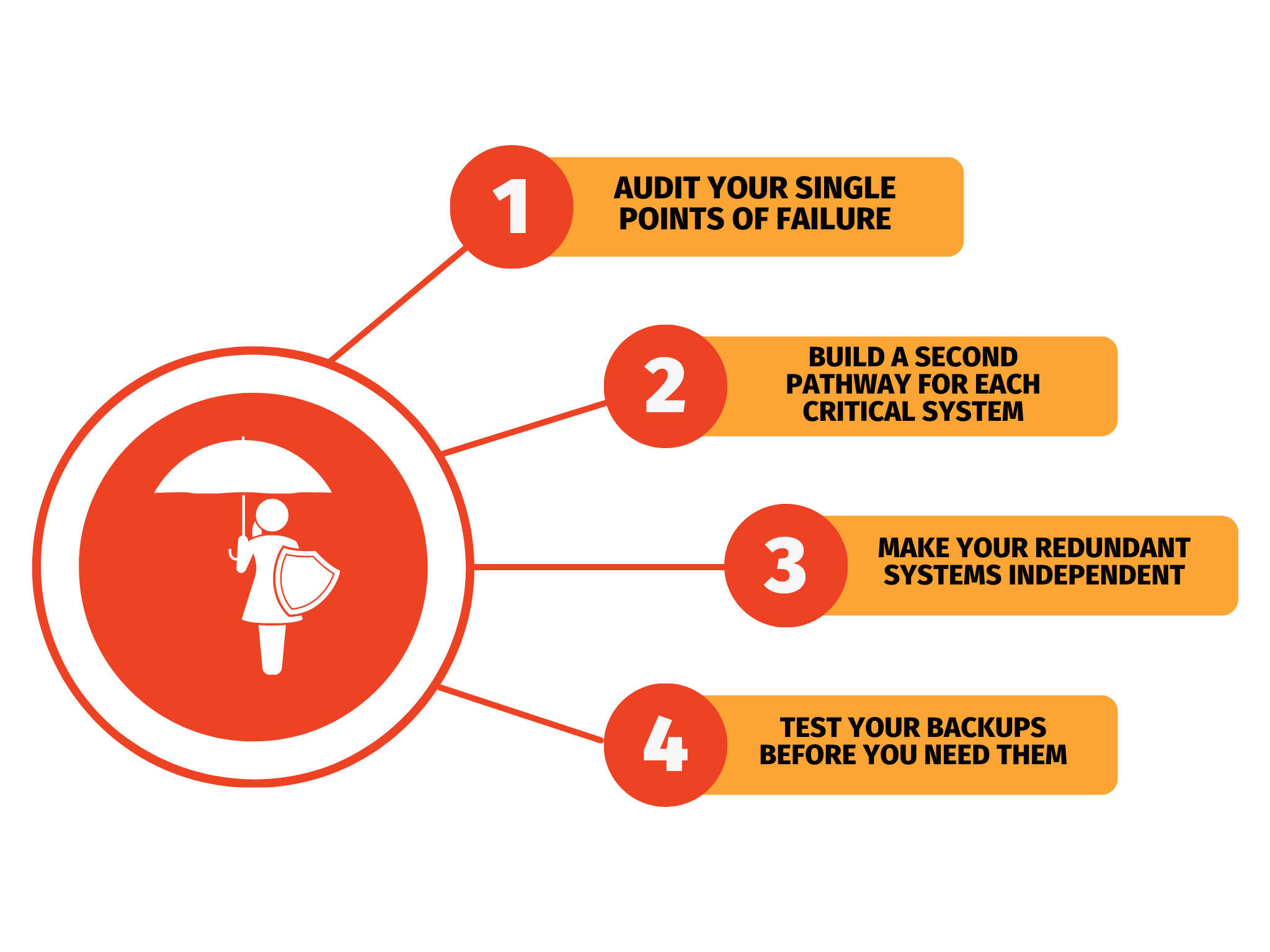
- Audit your single points of failure. List every component your creative career depends on. Income sources. Storage locations for work files. Platforms where your audience lives. Skills that generate revenue. Relationships that produce opportunities. For each one, ask: if this disappeared tomorrow, could I continue operating? Circle every item where the answer is no. Those circles mark hydraulic lines running through the same corridor. One explosion takes them all.
- Build a second pathway for each critical system. The novelist who stores manuscripts on one laptop adds a cloud backup and an external drive. Three copies, three locations. The freelancer who earns from one client cultivates two more warm relationships before the need arises. The musician who distributes through one platform establishes a presence on a second. If one system has a 1-in-1,000 chance of failing in a given year, two independent systems face a 1-in-1,000,000 chance of simultaneous failure. The math rewards even modest duplication.
- Make your redundant systems independent. Pixar's backup tapes died because they shared a flaw with the primary system: nobody tested them. The tapes sat in the same building, on the same network, maintained by the same team. A backup that shares failure modes with the primary mimics Redundancy without delivering it. Your cloud backup should use a different provider than your primary storage. Your second income stream should serve a different market than your first. Independence is the load-bearing wall.
- Test your backups before you need them. A backup you have never restored is a backup you are trusting on faith. Schedule a quarterly test: restore a file from your backup, call the secondary client when you don't need the work. Aviation engineers swap backup systems into active duty periodically to confirm they function under real conditions. Pixar's tapes looked fine from the outside. The corruption hid until the emergency arrived.
Mistakes to Avoid
- Confusing duplication with independence. Two copies of a manuscript on the same laptop equals zero Redundancy. The laptop gets stolen, both copies vanish. Two copies in two locations, on two devices, maintained through two different methods: that is Redundancy. What you need is a parallel system that cannot fail for the same reason as the primary.
- Building redundancy only in the dimension you've already lost. The photographer who suffered a hard drive crash buys three external drives and ignores the fact that her entire income runs through one wedding photography platform. Redundancy requires coverage across all critical systems. Scan every dimension: files, income, skills, relationships, platforms, tools.
- Treating redundant capacity as waste. Unused Redundancy feels like dead weight during calm periods. The temptation to strip it away grows every month nothing breaks. Then something breaks. A novelist with one hard drive. A freelancer with one client. A musician with one platform. Each runs lean until the lean snaps.
- Letting backups decay. A backup created once and never updated breeds false confidence. The novelist who backed up her manuscript six months ago has protected a version that no longer exists. Redundancy requires maintenance. Sync dates. Version checks. Relationship upkeep. The backup system that runs on autopilot degrades into theater.
The Creative Redundancy Checklist
Every creative professional should maintain parallel, independent systems across these nine domains. One pathway is a dependency. Two is Redundancy.
- Work files. Three copies minimum. One local, one cloud, one off-site physical backup. Update daily for active projects. Test quarterly by restoring a file from each backup.
- Income streams. Two active sources minimum. If one client provides more than 40% of your income, you carry a single point of failure wearing a paycheck disguise. Vine collapsed in 2017; creators who built audiences there and nowhere else watched years of work evaporate in a press release.
- Audience platforms. Two platforms minimum. Your newsletter list and one social channel. Or your website and a podcast. The creator whose entire audience lives on one platform has handed a corporation the power switch for their career.
- Key relationships. Three warm professional contacts for every critical role. People leave industries, change priorities, retire. One relationship is a dependency. Three is a network.
- Skills that generate revenue. Two marketable skills minimum. The illustrator who also writes copy. The filmmaker who also teaches. Skill Redundancy lets you pivot without starting from zero.
- Communication channels. Two ways for clients and collaborators to reach you. Email fails. Servers crash. Maintain two active contact methods with everyone who matters.
- Tools and equipment. A backup for every tool that stops your work when it breaks. Borrowing counts. Knowing who to call at midnight counts.
- Legal and financial records. Copies of contracts, tax documents, and intellectual property registrations in two locations, digital and physical. The document you cannot reproduce is the document that will matter most.
- Creative works in progress. Version history on every project. Save-as with date stamps. The accidental deletion, the corrupted file, the edit that destroys what it meant to improve: version history absorbs all of it.
The Paradox of Duplication
Creatives resist Redundancy with a consistency that borders on allergic. Building parallel systems feels wasteful, opposite to the lean commitment that artistry demands. The photographer carries one camera because two feels like doubt. The writer uses one platform because spreading effort feels like dilution. The freelancer serves one client because loyalty feels like integrity.
On November 4, 2010, Qantas Flight 32 tested those instincts at 7,000 feet. An Airbus A380 carrying 469 people departed Singapore. Four minutes after takeoff, a turbine disc in engine number two exploded, spraying shrapnel into the wing and severing a hydraulic line. In an aircraft with one hydraulic system, the flight ends there. The A380 carried three. The remaining systems held. The plane landed with 469 survivors.
Those extra hydraulic systems dragged on fuel efficiency for every uneventful flight. On one morning over Indonesia, they saved every person on board.
Build it early, when the systems are small and the cost of duplication is low. A second backup drive costs less than a single lost manuscript. A second income stream takes months to develop. Start before the emergency. The day you need it is the day you cannot build it.
Susman's workstation sat in her living room because she had a newborn and a job she loved. She hauled a Silicon Graphics machine across the Bay Bridge because she wanted to keep working. The Redundancy was incidental. The salvation was total.
Pixar learned. The studio now runs continuous backup verification, testing its systems the way airlines test hydraulics: by using them. The lesson cost two weeks of reconstruction and a story that became legend.
Every creative who hears the Toy Story 2 story laughs. Then goes quiet. Then checks whether their own files exist in more than one place. Eight people carrying a workstation on a sheet of plywood through a parking lot. Blankets and seatbelts in the back of a Volvo. A $100 million film riding across the Bay Bridge at 35 miles per hour, hazard lights blinking against the morning traffic.
Build it on purpose. Build it before the phone rings.