Alfred Hitchcock set Robert Bloch’s Psycho on a Paramount executive’s desk in the summer of 1959. The studio refused to touch it. Repulsive, the executives said. Impossible for films. Paramount would not finance it. Paramount would not let him shoot it on their soundstages. They owed him one more picture, and they wanted a glossy thriller in the vein of North by Northwest.
Hitchcock, at sixty, held the most reliable commercial track record in Hollywood. He had worked as the nail for four decades, building each picture inside the budget, cast, and schedule some executive handed down. He answered Paramount with a counterproposal.
He deferred his $250,000 director’s fee in exchange for sixty percent ownership of the finished negative. He moved production to Universal’s Revue Studios, where the crew from Alfred Hitchcock Presents shot for television rates. He filmed in black and white for $800,000 over thirty days. He cast Janet Leigh at $25,000, a quarter of her usual fee. He sent assistants to buy up copies of Bloch’s novel to keep the ending out of circulation.
With the film finished, he tightened every remaining screw. He banned press screenings. He forbade Leigh and Anthony Perkins from giving interviews. He ordered theaters to refuse admission to anyone who arrived after the picture started. Pinkerton guards stood in the lobbies enforcing the rule. Paramount, which had declined to fund the picture, now distributed it under terms Hitchcock wrote.
Psycho grossed over $32 million in 1960 on a budget under a million. Hitchcock’s personal profit came to $5 million, the largest payday of his forty-year career. Two years later he traded his remaining rights to MCA for 150,000 shares. He became the third-largest shareholder in the company that would come to own Universal Pictures. The no-late-seating policy he imposed on American theaters still stands.
Paramount had declined to throw him a rope. When the rope came into his hand, he kept it.
The Why
The Hammer and the Nail turns on an asymmetric truth about power. Leverage expires. Mercy from a position of leverage taxes your future self, because the person below you rehearses their own hammer swing while you hesitate.
An older formulation hits harder. When it is your turn to be the hammer, hit hard, because when you were the nail, no one had mercy on you.
Most creative careers oscillate between the two positions. Rejection letters stack up. Contracts arrive written by other people’s lawyers. Gatekeepers set the fees. Deadlines get enforced without negotiation. The creative learns the shape of the nail position early, and the lessons cut. Then a break arrives. A book hits. A gallery calls. A client bids against competitors for the same week. The polarity reverses.
The model addresses this moment. Leverage arrives. The creative feels it warm in the hand. The swing softens. They accept the old fee on the new project. They sign the standard contract. They settle for exposure when they could have taken equity. They extend professional courtesy to the people who gave them none. They confuse position with obligation. Goodwill does not convert into anything. Goodwill ages into an expectation of further discounts.
The pattern runs older than Hollywood. October 1806: at Prince Karl Lichnowsky’s country estate in Grätz, the Prince ordered Beethoven to play piano for French officers at dinner. Beethoven had spent fourteen years under Lichnowsky’s patronage in Vienna, drawn a 600-florin annuity, dedicated seven major works to the man who paid his rent. He locked himself in a distant room. Later that night he walked out in the rain with the Appassionata manuscript under his arm. The pages carry those water stains in the archive today. He reached Vienna, smashed the plaster bust of Lichnowsky on the floor, and sent back a note: “What you are, you are through chance and birth. What I am, I am through myself. There have been and will be thousands of princes. There is only one Beethoven.” Seven dedications before 1806. None after. The annuity had purchased deference. The deference was no longer for sale.
Hitchcock read the window. He had spent forty years making pictures on other people’s terms. Paramount’s refusal cracked the window open. He walked through it toward the structure of film ownership for the rest of his life.
The How
Four moves turn the swing into durable gain.
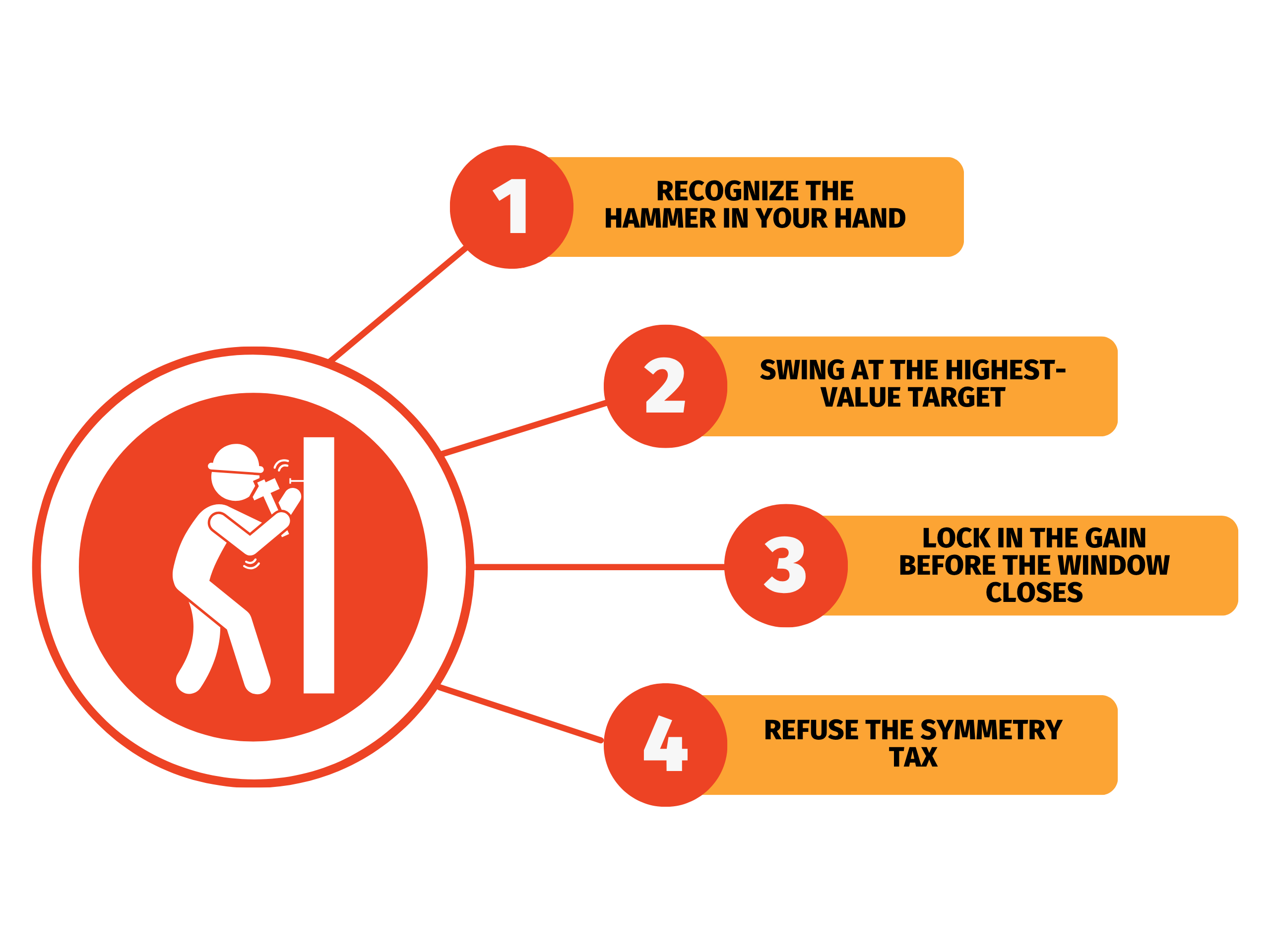
- Recognize the hammer in your hand. Leverage signals itself through small inversions: a gatekeeper returns your email within the hour. A client accepts your first number. A publisher calls to ask when you can meet. A contract arrives without the usual clauses. An opportunity carries a fear of losing you inside it. Most creatives miss these signals because the old reflexes keep firing. Keep a running log of pursuit signals from the last thirty days. The log forces the recognition the reflex blocks.
- Swing at the highest-value target. Leverage tempts you to ask for what you could not ask for last time. Creatives aim at bigger fees and softer deadlines. These gains compound small. The structural gains compound large: ownership, final cut, a license that reverts, a percentage of the back end, equity in the vehicle that carries the work. Hitchcock traded his entire director’s fee for sixty percent of the negative. The difference between those two moves, across twenty years, came to tens of millions of dollars and the foundation of his final studio deal.
- Lock in the gain before the window closes. Leverage moves like weather. It passes. Verbal agreements made during leverage shrink when leverage lifts. Convert leverage into paper before the weather changes: contracts, signed term sheets, exclusivity clauses, IP assignments, reversions. Paper outlasts the conditions that produced it. An author in the afterglow of a book deal has thirty to ninety days to turn verbal commitments into signed escalators, option terms, and film rights reversions. After that window, the publisher returns to baseline and the author loses the leverage that bought the favorable terms.
- Refuse the symmetry tax. Polite professionals extend mercy because mercy reads as a virtue. The reading costs. People who receive mercy in this position received none in yours, and they extend none in theirs. Asymmetric mercy taxes you twice: once in the deal you left on the table, a second time in the signal it sends future counterparties that your terms flex under pressure. Decline the tax. Take the ownership percentage the former rejector extends. Bill the full rate to the client who dragged out last year’s invoice. Let the editor who passed on your first book compete for your third with a real advance. Civility remains available in tone. Refusal lives in terms.
Exercise: Audit the last three negotiations in which you held leverage. Write down what you asked for. Write down what you could have asked for, with hindsight. Calculate the difference in current dollars, equity, or ownership. Fifteen minutes. You finish with a quantified cost of unused leverage. Carry the number into the next negotiation.
Tips and Tricks
- Make the counterparty name the ask first. Silence after an opening bid forces the other side to sweeten terms before you have spoken. Leverage owns the luxury of silence.
- Build a list of asks beyond the obvious one. Money sits first. Ownership, reversion rights, creative control, future-project options, and exclusivity carveouts compound over longer tails.
- Set a leverage expiration date in your calendar. The day a book hits the list, mark sixty days forward. Every call, meeting, and contract inside that window gets the hammer treatment.
- Keep receipts of the nail years. A folder of old rejection letters, lowball fees, and dismissive emails exists for one purpose: to neutralize the guilt that arrives when the polarity reverses. Read one before each negotiation.
- Separate the person from the position. A former rejector held a role that dictated their behavior. Occupy the position above them with the same discipline they showed above you.
Mistakes to Avoid
- Mistaking politeness for strategy. Creatives trained in the nail position develop deferential reflexes that feel like good manners and function like leaks. The email softens the ask. The fee rounds down. The thank-you concedes before the negotiation starts. Each of these costs money. Polite language costs nothing. Polite terms cost actual money.
- Hedging the swing at the exact moment of leverage. The peak of leverage sits on a narrow ridge. Most creatives feel the exposure and retreat toward safer asks. The safer ask lands below the deal the leverage supports. A counterparty willing to pay a hundred for the book treats a soft-ask of sixty as a forty-unit gift. Size the ask to the leverage at hand.
- Waiting until you feel you deserve the hammer. Positional leverage comes and goes, produced by market timing, scarcity, and luck. The window opens when specific conditions align for a specific length of time. Cosmic justice has no say in it. Act inside the window. The feeling of deserving it arrives eighteen months after the correct moment to act.
- Confusing hammering with cruelty. The Hammer and the Nail addresses terms. Tone can remain civil at no cost. Creatives who conflate the two end up in one of two ditches: swinging at nothing out of conscience, or swinging at everything out of grievance. Neither ditch pays.
- Swinging at the wrong target. The person across the table belongs to a different story than the people who wounded you in the nail years. Taking old resentments out on new counterparties burns capital and spreads reputation damage. Direct the hammer at structural gains. Direct the grievance elsewhere. Structural gains compound. Emotional releases do not.
The Leverage Audit
The hammer sits in most creatives’ hands unnoticed until the window closes. This audit surfaces active leverage in thirty minutes.
- List every active relationship where the other side wants something from you more than you want something from them. Clients, publishers, collaborators, platforms, former rejectors reaching back. Be specific. A vague sense of momentum is not leverage. A specific person waiting on a specific answer is.
- Name the leverage type for each position. Attention leverage expires in weeks. Money leverage expires in months. Reputation leverage expires in years. Contract leverage expires the day the pen hits the paper.
- Rank the positions by expiration speed. The fastest-decaying leverage goes to the top of the list.
- Write the ask you would make if the leverage expired tomorrow. For each of the top three, include the structural ask, the monetary ask, and the future-option ask.
- Calculate the gap between what you have been accepting and what you just wrote down. The gap is your leverage tax. You pay it with every negotiation you soften.
- Set a deadline for each ask. Put the deadlines in your calendar. Send the asks before the deadlines.
- Decline the first counteroffer. The first counteroffer in a position of leverage comes in below the second.
- Secure the result in writing within seven days of verbal agreement. Verbal wins evaporate. Signed wins persist.
The audit separates what you feel from what sits on the table. The residue from the nail years: unworthiness, guilt, imposter syndrome. None of it survives contact with a list of specific people waiting on specific answers.
The Hammer and the Nail does not guarantee the hammer stays in your hand. It guarantees someone will strike the next nail. The only open question: which side of the tool you occupy.
Hitchcock kept final cut on every film he made after 1960 and answered to no financier. The 150,000 MCA shares he acquired in 1962 carried him through every production until his death. The no-late-seating policy he imposed on American cinemas survived him by decades; every latecomer turned away from a major release re-enacts a term he wrote in 1959.
Paramount had a hammer in the summer of 1959. They used it to refuse him a soundstage. He took the refusal as instruction.