Raymond Loewy sat in a NASA conference room in Washington on October 14, 1969, and listened to an engineer explain why the astronauts would never look out a window.
He was seventy-five years old. He had drawn the Lucky Strike pack, the Studebaker Avanti, and the blue-and-white livery on Air Force One. Two years earlier, NASA had brought him in through its contractor Martin Marietta to make the first American space station livable, and the report he filed in February 1968 read like a list of charges: lights scattered at random across the ceiling, colors far too dark, cold fluorescent tubes where warm lamps belonged. George Mueller, the associate administrator for manned spaceflight, had already toured the mockup and said nobody could last two months inside it without going stir-crazy.
Most of Loewy's fixes cost little: a wardroom where the crew could eat facing each other, a pale yellow background to rest the eye, warmer light over the work areas. The engineers at Marshall Space Flight Center swallowed those. Then Loewy and the Houston designer Caldwell Johnson asked for a large window in the wardroom wall, and Leland Belew, Skylab's program manager, laid out the case against it. A window cost money. A window weakened the pressure hull. A window would take months to develop and test, and no experiment on the manifest needed one. Nobody in the room could argue with a single point.
Mueller turned to Loewy and asked for his opinion.
Loewy said the idea of flying without a window was unthinkable. On a long mission, he said, the recreational value alone would justify the cost. Mueller turned back to Belew and said, "Put in the window." The formal authorization went out on October 31.
Three crews lived aboard Skylab between May 1973 and February 1974, the last of them for eighty-four days. They ate at Loewy's triangular table, built so that no man could sit at its head, and they spent their off-hours at the window above it, passing binoculars back and forth over hurricanes and coastlines. Gerald Carr, who commanded that final crew, later told the New York Times that the men had grown so hungry for color they would stare at the test bars used to calibrate their cameras. The one thing on the station that never ran short of color was the view.
Loewy had been fighting this fight since 1934, when Sears handed him a squat industrial icebox called the Coldspot and asked him to make people want one. He kept the box. He smoothed its corners, gave it a latch that opened at a touch, and put rustproof aluminum shelves inside. By his own firm's count, Sears went from selling 60,000 refrigerators a year to 275,000 within two years. Every job after that ran on the same rule: push the object as far into the future as the buyer can follow, then stop one step before the buyer flinches.
He gave the rule a name. He called it MAYA, for Most Advanced Yet Acceptable.
The Why
The MAYA Principle holds that new work survives inside a narrow corridor. Push past what people recognize and they reject it. Stay inside what they already own and they ignore it. The corridor's width changes with the audience, the medium, and the year. Loewy laid out the tension in his 1951 memoir, Never Leave Well Enough Alone: adults resist the logical solution to their own problem when that solution asks them to abandon too much of what they have been trained to accept as normal. Two appetites run at once in every buyer, the hunger for the new and the fear of the too new, and every creative decision lands somewhere between them.
The window was pure MAYA. The most advanced habitat humans had ever built needed the oldest element in architecture before anyone could live in it.
The corridor turns up wherever an audience meets something unfamiliar. In July 2015, Spotify launched Discover Weekly, a playlist of thirty songs a listener had never played. Matt Ogle's team had built it to contain nothing familiar. During the first internal test, a bug let a few known songs slip in, and everyone filed it as a defect. The team fixed it. Engagement fell. When Derek Thompson interviewed Ogle for his 2017 book Hit Makers, Ogle explained that a little familiarity bred trust, especially for first-time listeners; a playlist with nothing to hook onto felt like a stranger's mixtape. The bug went back in on purpose.
Pop music has run the same experiment for sixty years. The I-V-vi-IV chord progression anchors "Let It Be," "Don't Stop Believin'," "No Woman, No Cry," and hundreds of other hits. The chords tell the ear it has been here before. The melody and the lyric supply the new. Listeners absorb strangeness because the harmony under it promises safety.
The MAYA Principle turns ambition into a targeting problem. The only measurement that matters is how much originality this audience will absorb before it stops listening.
The How
The corridor exists for every audience. The work is finding where yours begins and ends. Four steps locate it.
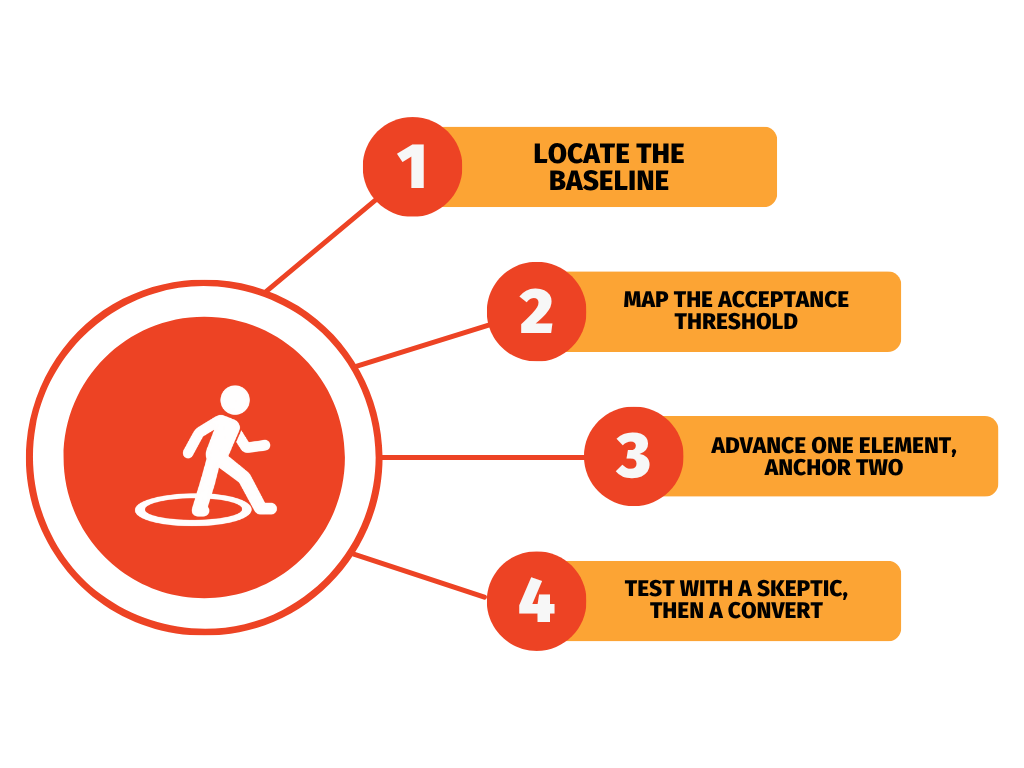
- Locate the baseline. List what your audience already treats as invisible: the formats, structures, and conventions they never comment on. A novelist's readers expect chapters. A podcast listener expects a host's voice within ten seconds. A gallery visitor expects work on walls. A nonfiction author preparing a first book can spend a week reading the Amazon reviews of ten comparable titles and noting which features reviewers mention without thinking: chapter length, tone, number of examples, reading level. The patterns nobody praises or complains about mark the floor.
- Map the acceptance threshold. Find the most advanced work your specific audience embraced in the past twelve months. That work marks the current edge. A jazz festival crowd tolerates more dissonance than a wedding reception; a design-literate buyer tolerates more abstraction than a mass-market shopper. Write down what that edge-work changed and what it kept. Your next project starts at that edge, and the corridor runs one step beyond it.
- Advance one element, anchor two. Loewy kept the Coldspot's shape, size, and place in the kitchen and changed only its surface. Apply the same ratio. For every element you push forward, hold two familiar. Write the radical argument inside a conventional essay structure. Package the experimental film as a genre piece. The familiar container earns the reader's trust, and the content does the advancing.
- Test with a skeptic, then a convert. Show the work to the person in your audience least likely to accept it, and watch for the first visible moment of discomfort. That flinch marks the boundary. Then show it to the person most likely to champion it. Their enthusiasm marks the ceiling. Adjust until the skeptic tolerates it and the convert celebrates it.
Exercise: Open your current project and list every element an audience meets: format, length, visual style, structure, tone, subject, medium, price. Aim for at least ten. Score each from 1 to 5, where 1 means standard in your field and 5 means nothing like it exists in your audience's experience. Score from their exposure, never from yours. Add the scores and divide by the number of elements. A result between 1.5 and 2.5 sits inside the corridor for most audiences; specialized audiences tolerate up to 3. If you land above that, convert one novel element back to convention. Fifteen minutes produces a calibration map you can reuse for every project.
Tips and Tricks
- Sequence your innovations. Release the most familiar version first. The Coldspot came before Loewy's streamlined locomotives for the Pennsylvania Railroad, which came before Studebaker, which came before Skylab. Each project widened the audience's baseline for the next. Your third book can break structures your second introduced.
- Study the Trojan horses in your field. Pick the three strangest works your audience embraced in the past five years and reverse-engineer what made them acceptable. The familiar elements they used are available to you.
- Design to one step before the flinch. Discomfort in a test reader is data. The point where it appears is your threshold for this audience, this year.
Mistakes to Avoid
- Calibrating to your own threshold. You have lived inside the work for months. Your audience meets it cold. A graphic novelist who has studied experimental panel layouts for a year sees her fragmented, non-linear grid as obvious. Her readers, trained on left-to-right panels, see chaos. Measure from their baseline.
- Mistaking novelty for value. The 1934 Chrysler Airflow was a genuine engineering advance: a streamlined body, weight shifted forward, a ride years ahead of its rivals. Buyers hated how it looked. Sales collapsed, and Chrysler killed the model in 1937. Advanced and acceptable are separate dials. Turning one all the way up does nothing for the other.
- Anchoring so hard the work goes flat. A song built on familiar chords, familiar lyrics, and familiar production is wallpaper. The MAYA Principle lives on tension between two poles. Remove either pole and the tension dies.
- Treating the threshold as fixed. What startled an audience five years ago reads as normal today. Streaming and social distribution compress the cycle further. Recalibrate for every project. The corridor moves.
How the Threshold Moves
Belew was right about the window in 1969. It did cost money. It did weaken the hull. It did take months to develop and test. He lost the argument because Loewy had already spent thirty-five years teaching Americans to accept objects that looked like the future, and Mueller had watched enough of those objects sell to trust him over a cost estimate.
The corridor moves because someone moves it. Each accepted advance becomes the next baseline, and the person who pushed the first advance gets to push the second from a better position. A window in a space station was radical in 1969. On February 8, 2010, the shuttle Endeavour carried the Cupola to the International Space Station: seven windows arranged in a dome, the central pane eighty centimeters across, the largest window ever flown in space. Astronauts now photograph hurricanes from it as routine. Nobody at NASA argues about whether a station needs a view. Three men staring at color bars in 1973 settled that.
This is the part most creatives miss. They picture the acceptance threshold as a wall they must either respect or crash through. It behaves like a tide line. Every piece of work that lands inside the corridor drags the line forward a few feet, and the work that follows can wade out farther than the work before it. The novelist whose first book kept every convention and changed only the voice has earned the right to break structure in the third. The designer who shipped the safe version this year ships the strange version next year, to an audience she trained herself.
Loewy never crashed through anything. He spent fifty years moving the line.
Loewy died in Monte Carlo on July 14, 1986, at ninety-two. The Shell logo he drew still hangs over gas stations. The livery he designed still flies on Air Force One. Skylab's orbit decayed until the station broke apart over the Indian Ocean and Western Australia on July 11, 1979, six years after the first crew floated up to the wardroom window and looked down at home.
The engineers had built a machine that could keep three men alive at 17,500 miles per hour for three months. Loewy's contribution was a hole in the wall with glass in it, and it was the one thing aboard that the crew would have gone stir-crazy without.