In 1943, American bombers were getting shredded over Germany. The military brought data to the Statistical Research Group at Columbia University: maps of bullet holes on planes returning from combat. The patterns looked clear. Holes clustered on the fuselage, wings, and tail. Almost none appeared around the engines.
The brass proposed armoring the areas with the most damage. Abraham Wald, a Hungarian-Jewish mathematician who had fled Austria ahead of the Nazi advance, saw something else entirely.
Armor the engines, he said. Armor the cockpit. Armor everywhere the bullets aren’t.
The officers stared. Wald explained: you’re only looking at the planes that came back. The ones hit in the engines never made it home. The holes in your data represent survivable damage. The absence of holes represents fatal damage. You’re studying the survivors and ignoring the dead.
The military armored the engines. Losses dropped. Wald had identified a cognitive error so fundamental it now carries his insight as its name: Survivorship Bias.
The Why
Survivorship Bias occurs when you draw conclusions from an incomplete dataset, one that excludes failures, dropouts, or the dead. You see what made it through the selection process and mistake that visible remainder for the whole picture.
The term gained its mathematical foundation through Wald’s wartime work, but the error is ancient. Roman engineers who built bridges still standing after two thousand years get credited with superior knowledge. The hundreds of Roman bridges that collapsed, killing their builders and erasing their techniques from history, vanished from the record. The survivors remain. The failures become invisible.
This matters for creative work because the advice industry runs almost entirely on survivorship bias. Every bestselling author who tells you to “write every day” succeeded while writing every day. You never hear from the thousands who wrote every day for decades and published nothing. Every famous painter who dropped out of art school becomes evidence that formal training kills creativity. The dropouts who became bartenders don’t give TED talks.
The music industry runs the same filter. A&R executives who signed one band out of ten thousand tell stories about “knowing the sound” when they heard it. They signed nine thousand nine hundred and ninety-nine other acts that dissolved into silence. The one hit validates the method. The nine thousand nine hundred and ninety-nine misses vanish from the story.
The advice you receive from successful creatives is pre-filtered for survival. The identical strategies, habits, and philosophies held by people who failed are permanently invisible. Failure has no publicist.
The How
Correcting for survivorship bias requires deliberate effort to study what didn’t make it through.
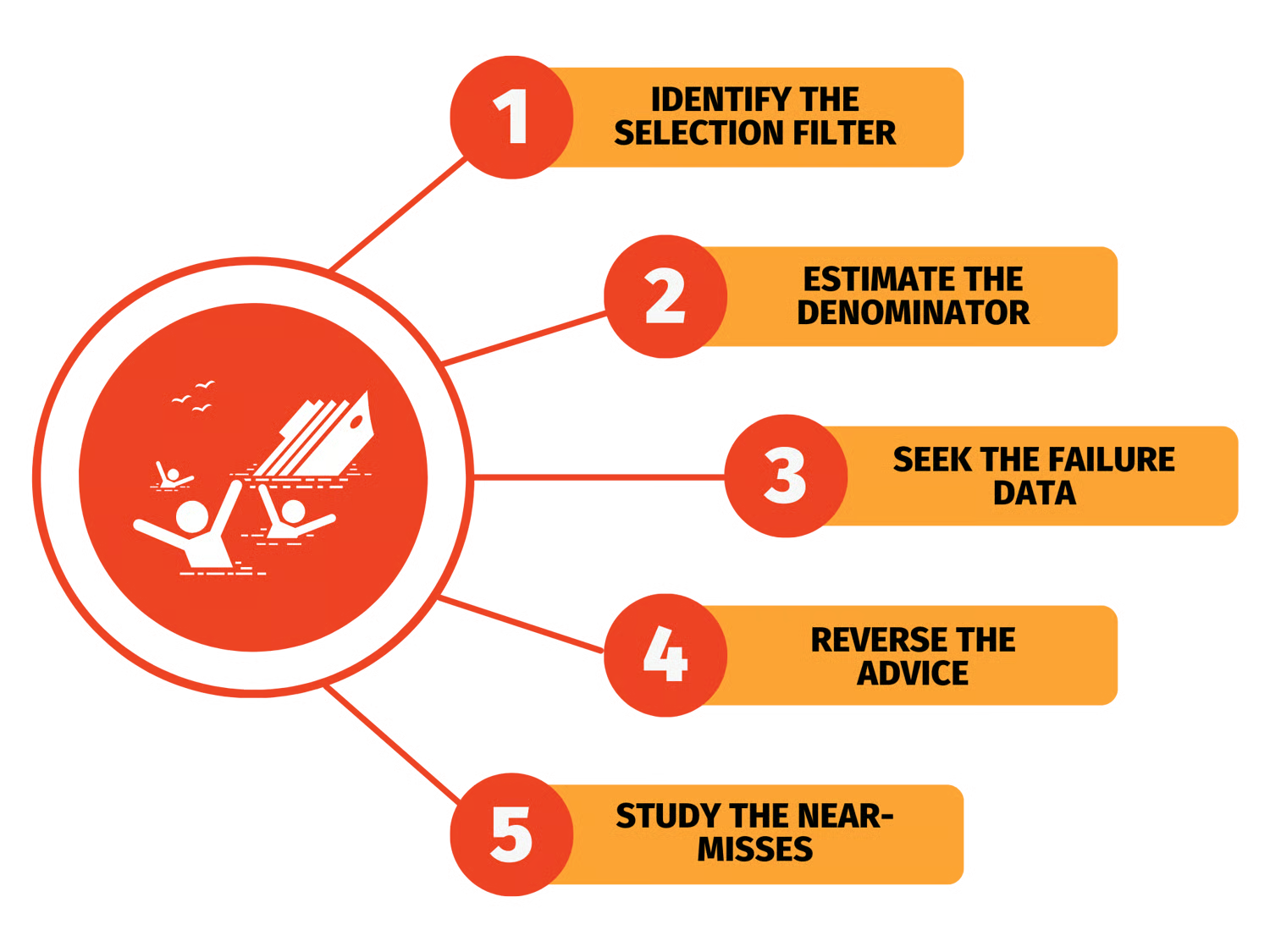
- Identify the selection filter. Every dataset you encounter has been filtered by something. Bookstore shelves show books that got published. Gallery walls show art that got selected. Podcasts feature guests who succeeded. Name the filter. Ask: what had to happen for this information to reach me?
- Estimate the denominator. For every success story you study, estimate how many attempts produced that one visible outcome. Bestseller lists represent roughly 0.1% of books published annually. Most businesses fail within five years. Most bands never get signed. The denominator tells you whether you’re looking at a replicable strategy or a lottery ticket.
- Seek the failure data. Hunt for information about what didn’t work. Read postmortems. Study shuttered businesses. Interview people who quit. This data is harder to find because failure doesn’t market itself, but it contains lessons success stories cannot offer.
- Reverse the advice. Take any piece of creative wisdom and ask whether the opposite could also correlate with success. “Successful writers wake up early” might be true. But if night owls who failed never get interviewed, you have no way to know whether wake-up time matters at all.
- Study the near-misses. The most valuable data comes from people who did almost everything right and still failed. They share most characteristics with survivors but didn’t make it through. The delta between them and the successes reveals what mattered versus what was merely present.
Tips and Tricks
- The cemetery test. Before accepting any success pattern as causal, visit the metaphorical cemetery. How many people followed the same pattern and are buried there? If you can’t answer, the pattern proves nothing.
- Base rates before anecdotes. Before studying what successful people do, learn the baseline probability of success in that field. A strategy that “worked for” ten famous authors means nothing if ten million unknown authors used the same strategy.
- Survivorship bias compounds with fame. The more successful someone becomes, the more their story gets retold and simplified. Original complexity and luck get edited out. Treat extremely famous success stories with extra skepticism.
- The bias hides in averages. Mutual fund performance statistics exclude funds that closed. Studies on company longevity exclude companies that died. Ask whether the data includes the dead.
Mistakes to Avoid
- Assuming survivors earned it. Survivorship bias combines toxically with just-world thinking. The desire to believe success is deserved makes us resist evidence that identical effort produced wildly different outcomes.
- Overcorrecting into cynicism. Recognizing survivorship bias doesn’t mean success is pure luck. It means you can’t determine causation from survivor data alone. Strategy still matters. You just can’t learn it from winners only.
- Ignoring the bias in your own history. The skills and habits you credit for your past successes might have been irrelevant. The failures where you applied the same approaches got forgotten. Your personal mythology is survivor-biased too.
- Confusing necessary with sufficient. Successful people often share certain traits. That doesn’t mean those traits cause success. Every plane that returned had wings. Wings were necessary but didn’t explain survival.
The Dropout Delusion
Steve Jobs dropped out of Reed College. Bill Gates dropped out of Harvard. Mark Zuckerberg dropped out of Harvard. These facts get cited as evidence that formal education stifles genius.
The counter-data: over 40 million Americans have dropped out of college. Three of them became tech billionaires. That’s a success rate of 0.0000075%.
College graduates earn on average 75% more than those with only high school diplomas over their lifetimes. The data on all dropouts, not the visible ones, suggests staying in school. Jobs, Gates, and Zuckerberg didn’t drop out into nothing. They dropped out of elite institutions with connections, safety nets, and access to capital. The narrative strips these advantages away, leaving a clean fable about genius rejecting convention.
Visible dropouts get documentaries. Average dropouts get student debt and silence. This pattern repeats everywhere creative advice gets dispensed. The visible survivors shape the narrative. The invisible failures pay the price.
Read the Slush Pile
The publishing industry keeps a database of failure. Literary agents receive between 5,000 and 11,000 queries per year each. In 1976, Judith Guest’s Ordinary People became the first unsolicited manuscript Viking Press accepted from the slush pile in 26 years. That’s the selection pressure.
You can read the slush pile. Literary magazines need first readers. Small publishers need interns. Contests need judges. These positions involve reading hundreds of submissions that will never see publication. Most creatives avoid this work. Reading bad writing when you could be producing good writing feels like a waste of time.
This is exactly backward. The slush pile is the cemetery Wald told you to visit.
When you read rejected work, patterns emerge that no craft book mentions. You see the specific ways openings fail to hook. You notice which premises feel tired before page three. You discover why competent prose still gets passed over, and the answer is almost never what the writing guides suggest. About 90% of submissions reveal themselves as insufficient within the first two pages. The remaining 10% teach you something harder to articulate: the difference between work that functions and work that compels. Published advice comes from survivors explaining what worked. Slush pile reading shows you the thousand ways things don’t work. Success leaves clues, but failure leaves blueprints.
There’s a second benefit. Slush pile submissions account for only 1-2% of published work. Editors solicit from people they know. Reading for a publication puts you inside the network. You meet editors. You understand their taste from the inside, watching what excites them versus what they reject.
Every creative field has its equivalent. Art schools have student exhibitions. Film festivals have submission portals. Music venues have open mic nights. The work that doesn’t advance tells you more than the work that does. Find the filter. Position yourself to see what it catches.
The survivors write the books. The slush pile holds the lessons.
The publishing industry keeps a database of failure. It’s called the slush pile: unsolicited manuscripts submitted by writers hoping to get discovered. Literary agents receive between 5,000 and 11,000 queries per year each. In 1976, Judith Guest’s Ordinary People became the first manuscript Viking Press accepted from the slush pile in 27 years. That’s the selection pressure.
Here’s what nobody tells you: you can read the slush pile.
Literary magazines need first readers. Small publishers need interns. Contests need judges. These positions are often unpaid or low-paid, and they involve reading hundreds of submissions that will never see publication. Most creatives avoid this work. It feels like a waste of time, reading bad writing when you could be producing good writing.
This is exactly backward. The slush pile is the cemetery Wald told you to visit.
When you read rejected work, patterns emerge that no craft book mentions. You see the specific ways openings fail to hook. You notice which premises feel tired before page three. You discover why technically competent prose still gets passed over, and the answer is almost never what the writing guides suggest. About 90% of manuscript submissions reveal themselves as not good enough very quickly. Reading slush teaches you to see what “not good enough” actually looks like in practice.
Published advice comes from survivors explaining what worked. Slush pile reading shows you the thousand ways things don’t work. The asymmetry is instructive. Success leaves clues, but failure leaves blueprints.
There’s a second benefit. Slush pile submissions account for only 1-2% of published work. Editors solicit work from people they know. Reading for a publication puts you inside the network. You meet editors. You understand their taste from the inside, watching what excites them versus what they reject. You see behind the curtain that separates the submission queue from the table of contents.
Every creative field has its equivalent of the slush pile. Art schools have student exhibitions. Film festivals have submission portals. Music venues have open mic nights. The work that doesn’t advance tells you more than the work that does. Find the filter. Position yourself to see what it catches.
The survivors write the books. The slush pile holds the lessons.
Wald looked at what wasn’t there and found the answer everyone else missed. The absent bullet holes told the real story. The present ones were distractions.
Every creative field has its own missing data. The authors who wrote daily and failed. The artists who quit their jobs and went broke. The musicians who moved to Nashville and drove home. Their stories don’t appear in interviews or masterclasses or advice columns. They exist only in the silence around success.
Study the silence. That’s where the useful information lives.