Chartres, 1194. A master mason stands in ash and charred stone. The cathedral has burned. His name is lost to history. He will not see what he is about to build.
His hands move across parchment anyway. Flying buttresses. Rose windows that will turn light into prayer. Stone ribs carrying vaulted ceilings toward heaven. Each line represents decades of labor by craftsmen not yet born. Problems to be solved by minds not yet conceived. Beauty to be witnessed by eyes that will not open for generations.
The master understands something contemporary creativity has forgotten. The most profound achievements emerge from patient accumulation across time spans that dwarf individual existence. He designs for the eternal conversation between human aspiration and stone. Between temporary mortality and permanent beauty.
The cathedral will take twenty-six years to complete its structure, another forty for consecration. The master will contribute a portion of that span to foundation work no visitor will see. Structural innovations no historian will credit to his name. Mathematical calculations forgotten long before the final spire pierces sky.
His legacy will be absorbed into collective achievement so completely that individual contribution becomes invisible. We know the bishop who commissioned the work, Renaud de Mousson. We know nothing of the builders who created it.
This is the Cathedral Model. Creative work that accepts its own incompleteness. That builds toward visions larger than single lifetimes can contain. That measures success in structural contribution to endeavors transcending the boundaries of personal creative mortality.
The Why
The Cathedral Model operates as antidote to creativity’s most toxic contemporary poison: immediate validation. Modern creative culture insists that work justify itself through likes, shares, sales, algorithmic approval. The Cathedral Model suggests something different. The most essential creative work may be precisely that which cannot be measured, marketed, or completed within conventional career timelines.
This temporal reframing reveals how creative anxiety emerges from chronological compression. The belief that artistic significance must manifest within the narrow window of an individual creative career. But the cathedrals demonstrate different mathematics of meaning. Creative work can achieve immortality through contribution to projects larger than any single imagination can conceive or execute.
The model’s psychological power lies in liberation from performance pressures that strangle authentic expression. When creators understand their work as contribution to ongoing cultural conversations rather than standalone achievements demanding immediate judgment, the paralyzing weight of creative expectations dissolves into purposeful craftsmanship.
Medieval cathedral builders worked within ecosystems that assumed individual artistic identity would be subsumed into collective achievement. No one remembers most sculptors who carved the gargoyles, glaziers who assembled the windows, mathematicians who calculated the stress loads. Yet their individual contributions created aesthetic experiences that continue generating spiritual and cultural value eight centuries after their deaths.
The Cathedral Model also provides strategic response to creative career sustainability challenges. Creators who build only for immediate success often discover that their work becomes dated when cultural tastes shift, technological platforms change, market conditions evolve. Creators who build for longer time horizons develop aesthetic approaches that can weather temporal fluctuations. They address fundamental human concerns instead of fashionable ones.
Antoni Gaudí’s Sagrada Família exemplifies this temporal durability. Construction began in 1882. Gaudí took over the project in 1883 and transformed it completely, dedicating the rest of his life to a building he knew would outlast him by generations. When he died in 1926, less than a quarter was complete. The Spanish Civil War destroyed most of his original plans. Yet construction continues. The basilica is scheduled for completion in 2026, one hundred years after his death, one hundred forty-four years after the first stone. Architectural styles have cycled through modernism, postmodernism, contemporary movements. Gaudí’s vision continues attracting nearly five million visitors annually. It engages with spiritual and aesthetic concerns that transcend particular historical moments. His willingness to work beyond his own lifetime enabled creative ambitions impossible within conventional career constraints.
The How
Implementing the Cathedral Model requires systematic reconstruction of creative timelines, success metrics, identity investments. This involves both practical project management strategies and psychological reorientations that support sustained work without immediate validation.
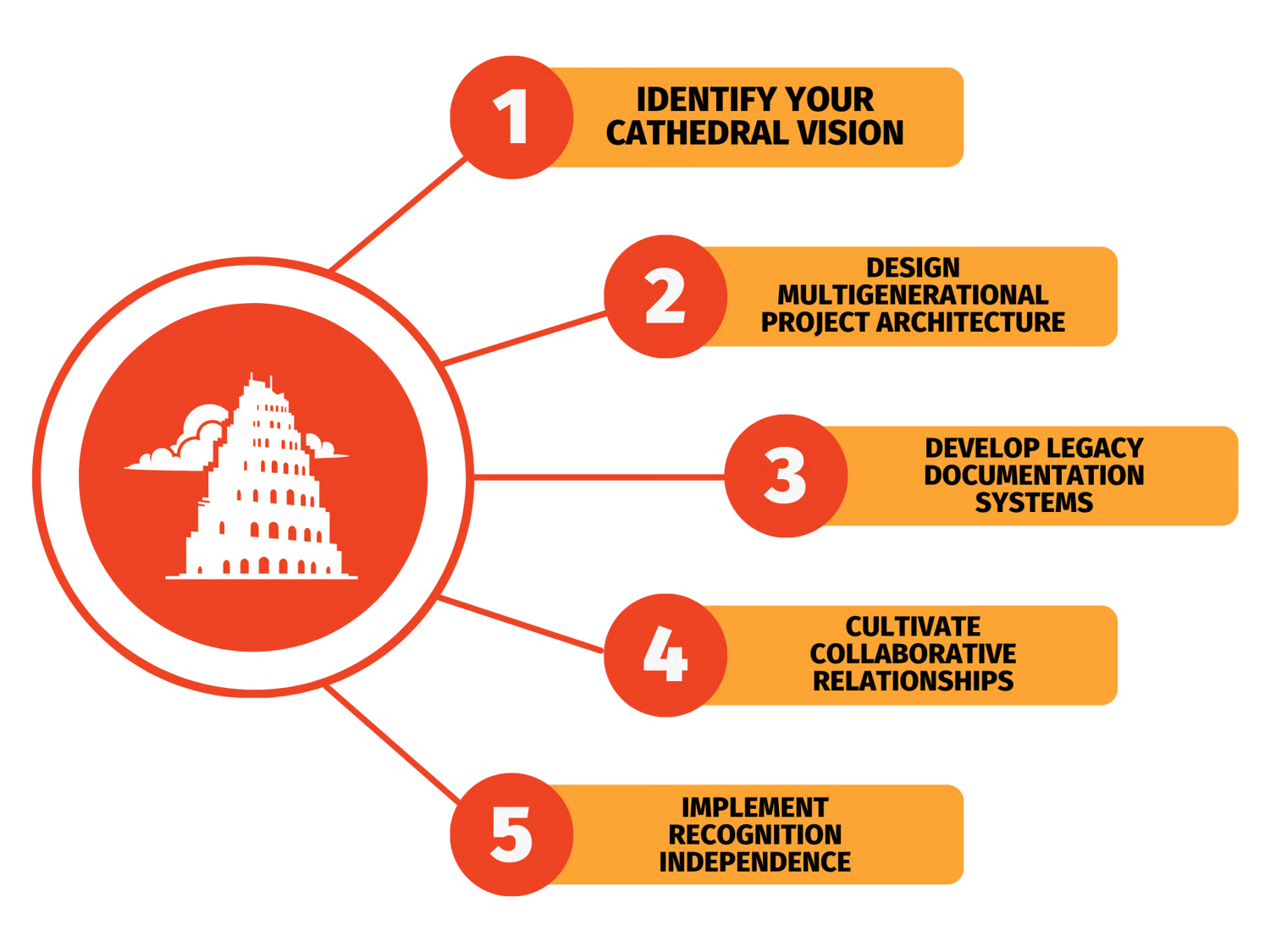
- Identify your cathedral vision. Define the overarching creative contribution you want to make across your entire career. Treat individual projects as stones in a larger architectural structure. This vision should feel simultaneously inspiring and impossible. Too large for any single project to fulfill. Too important to abandon when individual efforts face setbacks. Document this vision in concrete terms that can guide daily creative decisions while remaining flexible enough to evolve.
- Design multigenerational project architecture. Structure your creative work across multiple timescales. Daily craftsmanship that builds technical skill and maintains creative momentum. Annual projects that advance your cathedral vision incrementally. Lifetime goals that may require decades to achieve. Create explicit connections between these temporal layers so that daily work serves long-term architectural purposes.
- Develop legacy documentation systems . Create comprehensive records of your creative process, decision-making rationale, technical innovations. This documentation serves both practical and psychological purposes. Practically, it enables others to continue your work if necessary. Psychologically, it reinforces your role as contributor to ongoing creative traditions rather than isolated individual performer seeking personal recognition.
- Cultivate collaborative relationships. Build connections with other creators who share compatible long-term visions. Create informal networks that can support cathedral-scale projects across multiple careers and generations. These relationships should focus on shared creative goals rather than individual advancement.
- Implement recognition independence. Develop creative satisfaction sources that don’t depend on external validation. Build identity around craftsmanship quality, vision advancement, contribution to larger creative conversations. This internal validation system must provide sufficient psychological sustenance to maintain creative momentum through extended periods without external confirmation.
Tips and Tricks
- Create ritual practices that connect daily creative work to your larger cathedral vision . Use consistent environmental cues or ceremonial elements that reinforce the transcendent aspects of your creative commitment.
- Build tolerance for creative loneliness. Cathedral work often requires extended periods of solitary labor that may not be understood or appreciated by contemporaries who operate on different temporal scales.
- Develop multiple projects at different completion stages. Finishing individual pieces provides psychological satisfaction while the larger cathedral vision remains perpetually under construction.
- Study historical examples of multigenerational creative projects. Understand practical strategies previous creators used to maintain vision coherence across extended time periods and multiple contributors.
- Practice strategic secrecy about your cathedral vision. Share details only with people who can provide meaningful support.
- Build financial and lifestyle sustainability that supports decades of work without requiring immediate commercial success from your cathedral projects. Treat other income sources as foundation work that enables your primary creative architecture.
- Document your creative evolution through regular reflection. Track how individual projects contribute to your larger vision while identifying when course corrections may be necessary.
Mistakes to Avoid
- Using the model as excuse for self-indulgent projects that serve ego rather than authentic creative vision . Mistaking personal monument building for genuine contribution to cultural conversations.
- Becoming so focused on future vision that current work lacks care, attention, quality. Treating daily creative labor as mere stepping stones rather than meaningful achievements worthy of craftsmanship excellence.
- Using cathedral work as justification for complete withdrawal from creative community. Missing opportunities for collaboration, feedback, support that could enhance long-term vision.
- Maintaining cathedral plans without adaptation as understanding deepens through experience. Treating initial concepts as sacred rather than allowing evolution based on accumulated insight.
- Using lack of immediate success as evidence of cathedral authenticity. Developing unhealthy attachment to obscurity that prevents legitimate opportunities for work to find appropriate audiences.
- Panicking when individual projects finish because they represent progress toward cathedral completion. Preferring perpetual work-in-progress status to the vulnerability of presenting finished contributions.
What Time Reveals
Vincent van Gogh painted swirling skies and vibrant landscapes for audiences that didn’t exist yet. The Parisian art establishment rejected him. He painted anyway. His letters reveal someone who understood his work as contribution to painting’s ongoing evolution. He painted with urgency because he felt the shortness of his individual lifespan. He painted toward a future he would never see.
This temporal displacement of judgment transforms creative work from performance to research. From entertainment to investigation. From product to process. The creator who builds cathedrals accepts that their work may be misunderstood, ignored, actively rejected by contemporaries. They maintain faith that authentic creative contribution will eventually find its place within larger cultural structures developing across time.
James Joyce spent seventeen years writing Finnegans Wake. Created linguistic innovations that readers are still learning to decode nearly a century after publication. His willingness to work beyond immediate comprehension enabled experiments in narrative structure and language use that continue influencing writers who never directly encounter his work.
The Cathedral Economics
Medieval cathedrals had no Kickstarter campaigns. No venture capital. No book advances or gallery representation. They had something better: the building fund.
Every Sunday, every feast day, every wedding and funeral, coins dropped into the cathedral fund. A farmer’s penny. A merchant’s silver. A noble’s gold.
This is the secret contemporary creators miss. They structure creative financing like military campaigns. Raise money, execute project, seek next funding. Cathedral builders structured financing like respiration. Breathe in, breathe out, keep breathing.
Your actionable cathedral fund: Open a separate account. Name it your cathedral. Contribute something every week. Ten dollars. Fifty. Whatever amount you can sustain indefinitely. This is not project funding. This is infrastructure funding. This money exists only to keep the cathedral alive during periods when individual projects fail, when markets collapse, when audiences disappear.
The medieval building fund could sustain construction through wars, plagues, economic depressions. Cologne Cathedral began in 1248. Work halted around 1560. The crane that stood atop the unfinished south tower remained there for four hundred years, a silhouette against the German sky. Construction resumed in the 1840s. Completed in 1880. Six hundred thirty-two years from first stone to last. The fund outlasted generations.
Structure your creative life the same way: Twenty percent of earnings into the cathedral fund. Always. When projects succeed wildly, twenty percent. When projects fail completely, twenty percent. The fund accumulates. The fund provides. The fund outlives your temporary failures and successes both.
Medieval cathedrals survived because builders understood something venture capital will never grasp: immortal projects require immortal funding structures. Sustainable breath.
The Cathedral Model offers liberation from the tyranny of now. The master masons of Chartres laid foundations they would never see completed. Vincent van Gogh painted for audiences not yet born. James Joyce wrote sentences readers would decode for centuries.
Your work exists within the same temporal architecture. Contributing to conversations that extend beyond your breathing years.