Charles Dickens sat at his desk in Devonshire Terrace on an October evening in 1843, reading sales figures for a novel that was bleeding readers. Martin Chuzzlewit, his sixth book, serialized monthly by Chapman & Hall, had peaked at 23,000 copies per installment and was dropping. His publishers invoked a clause in his contract: if sales fell further, his monthly payment of £200 would shrink by £50. His wife Catherine was pregnant with their fifth child. He could keep grinding on Chuzzlewit and hope readers came back. He could accept more speaking engagements, more editorial commissions, more of everything that paid now.
Instead, Dickens picked up a second project in the margins of the first. He began writing a Christmas ghost story nobody had asked for, composing scenes during fifteen-to-twenty-mile nighttime walks through London, returning home to put them on paper until dawn. Six weeks later, A Christmas Carol existed. The first printing of 6,000 copies sold out by Christmas Eve.
Chapman & Hall did not finance the book. Dickens paid for production himself, insisting on gilt-edged pages, hand-colored illustrations by John Leech, and red cloth binding. He set the price at five shillings. Production costs devoured the profits. Pirated editions flooded the market within weeks. The Carol earned him £230 on the first run, a fraction of what he expected.
It made him immortal.
The serialized novel demanded his hours. The Christmas story asked for something he could barely afford to give: his attention on the Carol, at the moment the Carol mattered to no one but him.
The Why
In August 1954, Dwight Eisenhower addressed the Second Assembly of the World Council of Churches at Northwestern University in Evanston, Illinois. He quoted an unnamed former college president: “I have two kinds of problems, the urgent and the important. The urgent are not important, and the important are never urgent.”
Eisenhower knew the distinction from experience. As Supreme Commander of Allied Forces in World War II, he sorted thousands of decisions daily. Cables arrived every hour. Officers demanded answers. The pressure to respond to whatever burned hottest never let up. The commanders who lasted through long campaigns learned to tell the difference between signals that required action and signals that would resolve on their own while the real work continued elsewhere.
Stephen Covey turned Eisenhower’s observation into a four-quadrant matrix in his 1989 book The 7 Habits of Highly Effective People. The Eisenhower Matrix plots every task on two axes: urgency and importance. Urgent tasks demand attention now. Important tasks advance your actual goals. The intersection creates four territories.
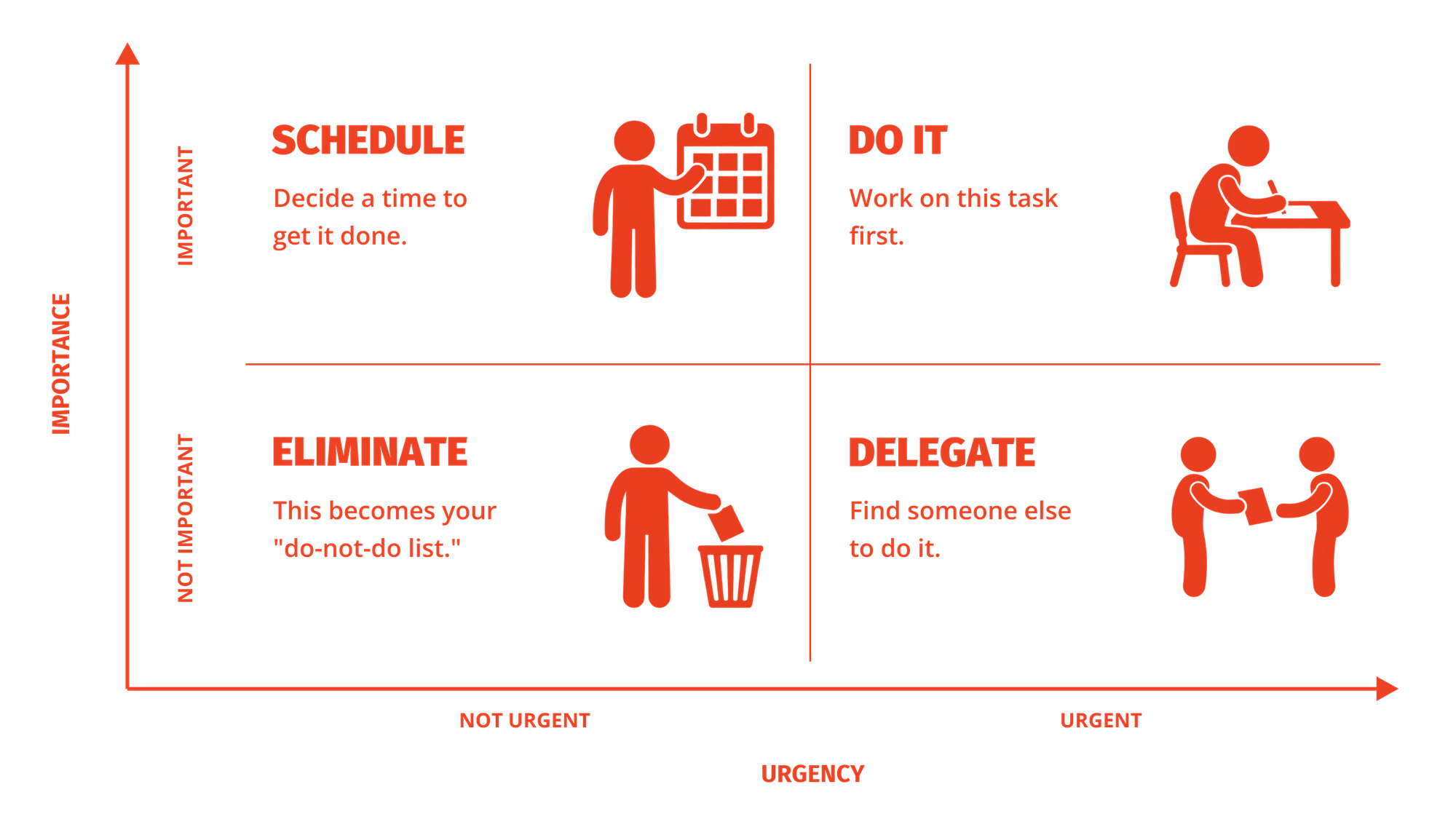
- Quadrant 1: urgent and important. The gallery deadline for your strongest work, due in five days.
- Quadrant 2: important, never urgent. The novel you keep meaning to start, the portfolio overhaul that could redefine your career, the skill that separates you from where you want to be.
- Quadrant 3: urgent, unimportant. Most emails, most meetings, most favors people need by Friday.
- Quadrant 4: neither urgent nor important. Social media scrolling, busywork, creative procrastination disguised as research.
In 2018, researchers Meng Zhu, Yang Yang, and Christopher Hsee published a study in the Journal of Consumer Research that tracked how people choose between tasks of varying urgency and importance. Across five experiments, subjects consistently chose tasks with short deadlines over tasks with larger payoffs, even when the urgent tasks were objectively worse. Zhu and her colleagues named it the mere urgency effect. The bias held even when subjects knew the important task paid more. The illusion of a ticking clock was enough to override the math.
The Eisenhower Matrix maps this damage. Most creatives occupy Quadrant 3 without knowing it. They answer the email within minutes. They attend the meeting that could have been a message. They handle the client’s “quick question” that consumes an hour. Each task arrives with a short fuse and a loud voice, displacing the work that has no fuse at all: the work in Quadrant 2, where no one is asking and no deadline exists, where the only pressure comes from the creator who recognizes that this is the work that compounds over a career.
Dickens in October 1843 faced a Quadrant 1 crisis: falling income, a contracting publisher, a fifth child on the way. The daily grind pulling at his hours, the speaking engagements, the editorial commissions, the effort to prop up Chuzzlewit’s sales, all lived in Quadrant 3. The story burning in his head, the one no one needed by any date, lived in Quadrant 2. He chose Quadrant 2. That choice still compounds 180 years later.
The How
Zhu’s research proved that people misjudge where their hours go, even when they know the stakes. The audit corrects the misjudgment. Four steps, on paper, no shortcuts.
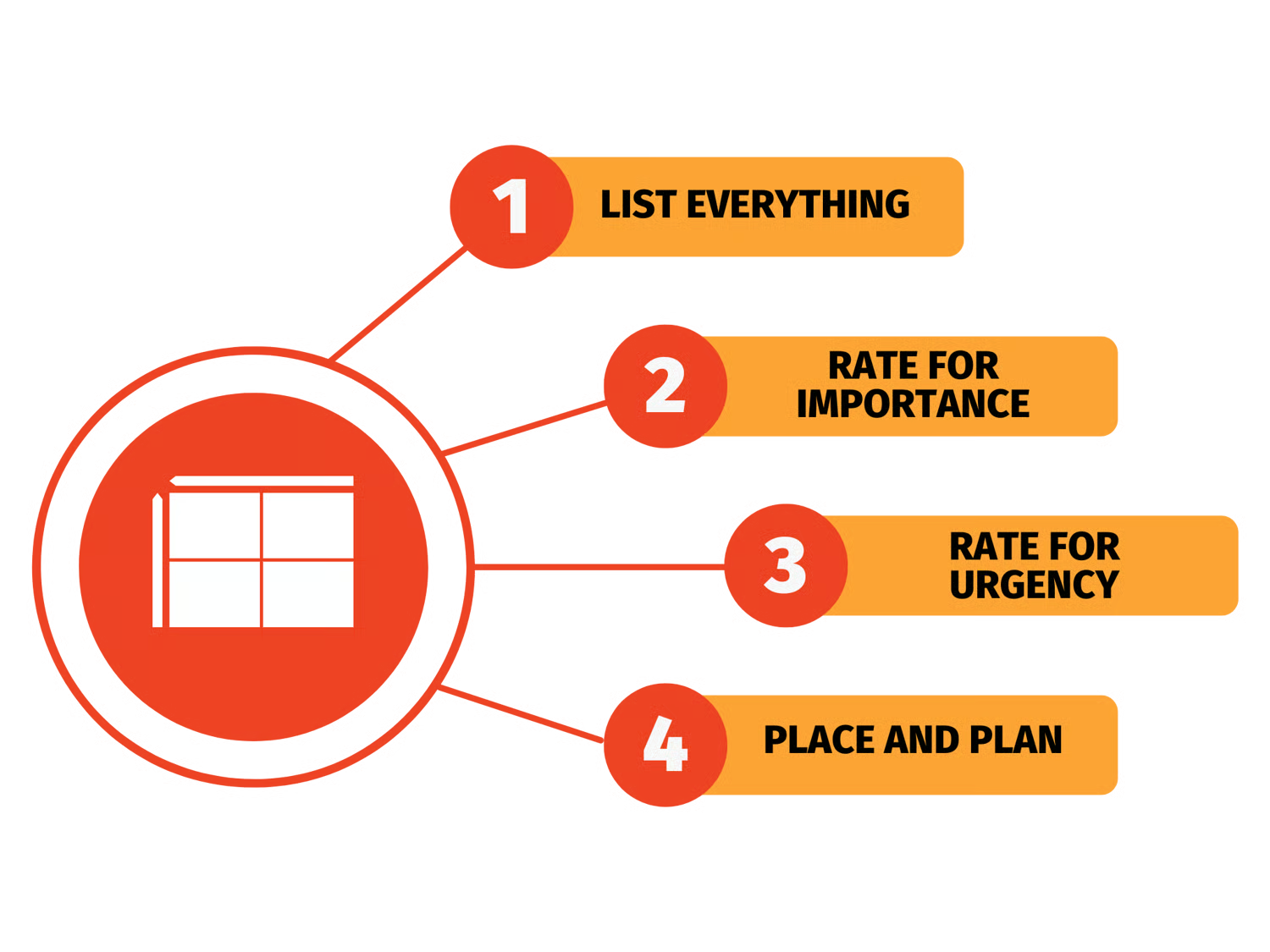
- List everything. Write every task, project, commitment, and obligation occupying mental space. Complete inventory. Twenty items minimum. Most creatives hit fifty once they start counting. Include the novel outline sitting in your head, the client revision due Friday, the social media you “should” post, the networking event next week. If it occupies cognitive space, it belongs on the list.
- Rate for importance. Score each item on alignment with your creative goals. The portfolio piece that could land the client you want: important. The portfolio piece that fills space but excites nobody: unimportant. Importance answers one question: does this compound toward the work you want to be remembered for? If someone else would benefit more from this task getting done than you would, you are looking at urgency wearing an importance costume.
- Rate for urgency. Mark genuine deadlines. Client deliverables with signed contracts. Exhibition submissions with postmark dates. Ignore artificial urgency. The revision that “should” happen soon: non-urgent. The networking event you “ought” to attend: non-urgent. Urgency means specific consequences arrive within days if you do nothing.
- Place and plan. Drop each task into its quadrant. Then build your calendar from the matrix. Quadrant 1 gets done today. Quadrant 2 gets scheduled blocks every week, defended the way you defend client meetings, because the client is your future self. Quadrant 3 gets batched into thirty-minute windows twice daily. Quadrant 4 gets deleted.
Tips and Tricks
- Schedule Quadrant 2 before anything else touches your morning. Zhu’s research showed that urgency overrides importance when both options sit side by side. Remove the competition. Do the important work before the urgent work arrives.
- Review weekly. Sit down Sunday night. Track your previous week: hours per quadrant. Most creatives discover they spent forty hours responding to other people’s priorities and zero hours on the project that could change their career. The numbers show what guilt obscures.
- Make Quadrant 2 visible. Pin the novel outline to your wall. Leave the portfolio redesign checklist where you see it every morning. Important work without urgency turns invisible. Force it into your sight line or lose it to the tasks that shout louder.
Mistakes to Avoid
- Treating every fire as a crisis. A client’s angry email feels like Quadrant 1. Most client disputes resolve within 48 hours regardless of when you respond. Eisenhower watched officers exhaust themselves reacting to every urgent cable. The decisions that mattered arrived after the attention was already spent. Pause before responding. The fire you ignore at 9 a.m. is often ash by noon.
- Letting Quadrant 2 decay into Quadrant 1. The portfolio becomes urgent when a dream opportunity requires it and it does not exist. The skill becomes urgent when a project demands it and you cannot deliver. Every neglected Quadrant 2 item migrates to Quadrant 1 eventually, dragging crisis energy behind it. Prevention costs less than emergency response. Schedule the prevention.
- Confusing other people’s importance for your own. A colleague’s deadline feels like your urgency. A client’s preference feels like your priority. The Eisenhower Matrix works only when you rate importance against your goals. The moment you start rating against someone else’s goals, you occupy their matrix. You work for them now.
- Ignoring Quadrant 4. Social media research, industry news scanning, reorganizing your workspace for the third time this month. These activities orbit creative work without producing any. They feel like preparation. They function as avoidance. Track your Quadrant 4 hours for one week and total them.
The Compound Cost of Urgency
Zhu’s study revealed something beyond the mere urgency effect itself. When researchers prompted participants to consider the long-term consequences of their choices before selecting a task, the bias reversed. People chose the important task. The effect collapsed the moment subjects paused long enough to see it operating.
The Eisenhower Matrix forces that pause.
Creative careers compound in Quadrant 2. The daily writing habit produces a manuscript in eight months. The skill acquisition takes a year to mature and opens a decade of new work. None carry deadlines. All compound.
A photographer who spends three hours each morning answering emails has chosen to compound in Quadrant 3. At the end of a year, she holds 780 hours of answered correspondence and zero hours of the personal project she tells everyone she plans to start. A photographer who blocks those same three hours for her own work holds a body of work. The inbox survived without her. It always does.
You never see the novel that went unwritten or the career that went unlived. You see only the emails you answered and the meetings you attended. Urgency leaves evidence everywhere. Importance, neglected, leaves no trace at all.
Dickens wrote A Christmas Carol in the gaps between Chuzzlewit installments. His sister-in-law described him weeping while he wrote, laughing while he wrote, pacing London’s streets past midnight to compose scenes in his head. The “proper” novel, the one that paid the bills, the one Chapman & Hall contracted, continued on schedule. Chuzzlewit finished its serialization in July 1844. Scholars remember it as minor Dickens.
The Carol endures. It has been translated into every major language and adapted hundreds of times. Dickens wrote it when nobody asked, during weeks he could not spare.
Quadrant 2 repays on its own schedule. The interest rate is immortality.