
On September 26, 1944, a Black woman walked into Decca Records’ New York studio with an electric guitar. Sister Rosetta Tharpe had spent six years recording gospel in conventional arrangements. This session would gut those conventions entirely. She plugged in, nodded to pianist Sammy Price, and laid down “Strange Things Happening Every Day.” The guitar riffs crackled with distortion. The rhythm hit harder than anything gospel audiences had absorbed. By April 1945, the song reached number two on Billboard’s race records chart, the first gospel record to cross over.
The church community that raised her recoiled. You don’t play Satan’s instrument in nightclubs alongside scantily clad showgirls. You don’t shred electric guitar if you’re a woman.
Tharpe did all of it.
Here is the detail the outrage buried: she had earned the right to demolish what she loved. A prodigy since childhood, touring churches across the South by age six, she had mastered traditional gospel so completely that her community counted her among its finest voices. She mapped every wall of the tradition. She knew exactly which one she removed when she plugged in.
A decade before Chuck Berry cut his first single, Tharpe had already forged the sound he would make famous. Berry reportedly called his career “one long Sister Rosetta Tharpe impersonation.” Little Richard named her his greatest influence. Elvis, Jerry Lee Lewis, Johnny Cash, Carl Perkins: all studied her records, absorbed her showmanship, built their legends on her foundations.
One question went unasked: why did Tharpe’s revolution last when other genre experiments vanished without a trace?
The Why
Margaret Boden spent her career at the University of Sussex dismantling a single mystification: the belief that creativity resists analysis.
In her 1990 book The Creative Mind: Myths and Mechanisms, she replaced the mysticism with mechanics. Creativity operates through distinct, learnable processes. She identified three types. The relationship between them turns out to matter more than any one type alone.
- Combinational creativity rearranges existing elements. A griffin fuses eagle and lion. A smartphone fuses telephone, camera, and computer. Most brainstorming sessions produce combinational output. The pieces already exist; the creator shuffles them.
- Exploratory creativity pushes deeper into an established space, mapping what its rules permit. A jazz musician improvising within chord changes. Bach writing the Goldberg Variations, charting the outer reaches of counterpoint while obeying its every law. The rules stay intact; the creator discovers rooms the house always contained.
- Transformational creativity demolishes the space itself. The square root of negative one defied existing mathematics until mathematicians invented imaginary numbers, rewriting what “number” could mean. Arnold Schoenberg, starting in 1908, dismantled the gravitational pull of key centers that had organized Western music for centuries. The rules don’t bend. They shatter. And something previously unthinkable becomes possible.
The three types look like a menu, yet they function as a ladder.
Combination requires knowing the pieces. Exploration requires knowing the space those pieces occupy, its edges, its hidden architecture. Transformation requires knowing the space so thoroughly that you can identify which specific wall, removed, opens territory worth occupying.
Tharpe climbed every rung. She combined gospel, blues, and swing in her early career, learning the raw materials. She explored gospel’s possibilities for years, pushing her vocal range, her guitar technique, her stage presence to the edges of what the tradition permitted. When she finally dropped the constraint that gospel belonged exclusively in church, she dropped it with surgical precision. The revolution endured because the revolutionary had mastered what she was about to destroy.
The same sequence surfaces in every domain where transformation lasts. The graphic designer who reinvents branding first spent years mastering typography within existing conventions. The entrepreneur who disrupts an industry first mapped its economics, its customer psychology, its structural assumptions. The novelist who shatters narrative form first wrote within it well enough to understand what the conventions were doing.
Boden also distinguished P-creativity (new to the individual) from H-creativity (new to human culture). The cognitive processes are identical. Only the audience differs. P-creativity is training. Every time you work through the combinational-exploratory-transformational sequence on a personal scale, you build the muscles for doing it on a historical one.
The How
Five steps. Each moves you one rung up the ladder.
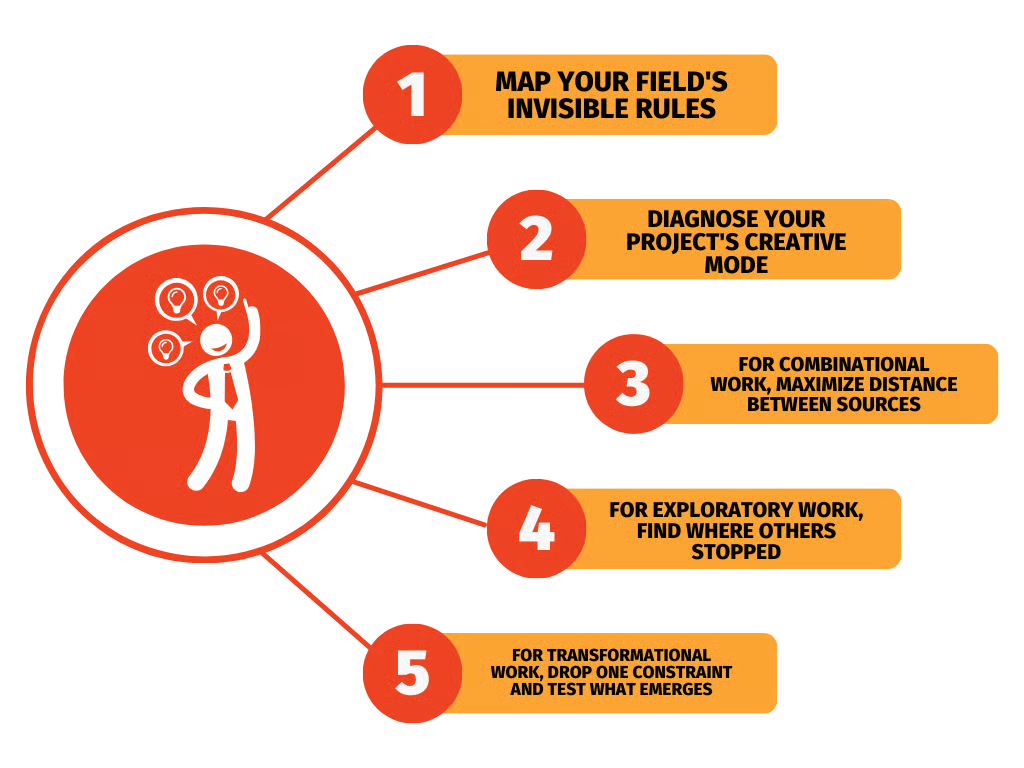
- Map your field’s invisible rules. Take a sheet of paper. Write your current project at the top. Below it, list every rule you follow without questioning. Genre conventions. Technical constraints. Inherited beliefs about what counts as appropriate, possible, valuable. Push for fifteen entries. The rules that feel so natural you struggle to articulate them are the load-bearing ones.
- Diagnose your project’s creative mode. Three questions. Does this project need to communicate within existing expectations? Combinational. Does this project need to push what’s possible within a known form? Exploratory. Does this project need to create something the current rules can’t contain? Transformational. The answer shapes everything that follows.
- For combinational work, maximize distance between sources. Proximity kills combination. Mixing rock and country yields predictable results. Mixing West African polyrhythms with minimalist classical composition gave Steve Reich Drumming in 1971, an entirely new sonic architecture forged from the collision. Identify the core problem your project solves. Find an analogous problem in a completely unrelated field. Import the structural logic, not the surface details.
- For exploratory work, find where others stopped. Pick three creators you admire. For each, identify one technique that pushes convention without breaking it. Ask: what happens if someone pushes that technique twice as far? The wall you hit during exploration is diagnostic. If the wall is a convention that feels like a limit, you’ve found your next exploratory target. If the wall is genuine, you’ve found a candidate for transformation.
- For transformational work, drop one constraint and test what emerges. Return to the list from Step 1. Circle the three most foundational rules. For each, write one sentence describing what your project looks like if that rule vanishes. Most of what you produce will fail. Dropping constraints at random generates noise. The creative act is choosing which constraint to drop, the one whose removal opens genuinely valuable territory. The Bauhaus architects dropped the constraint that buildings must reference historical ornament. They produced glass, steel, and open floor plans because they had spent years studying what those ornaments were actually doing. Tharpe preserved gospel’s emotional intensity while eliminating its stylistic limitations. Transformation that lasts always preserves the function of what it destroys.
Pro-tip: If “everyone just knows” something in your field and nobody can explain why, you’ve located a structural assumption. Those assumptions are where transformation lives.
Exercise: the Constraint Inventory (15 Minutes)
Choose a current project.
Minutes 1–7: List every rule, convention, and assumption governing it. Fifteen entries minimum.
Minutes 8–12: Mark each rule C (recombine with other fields), E (push further within existing norms), or T (drop entirely).
Minutes 13–15: Pick one T entry. Write a single paragraph describing the project without that rule.
You finish with a combinational toolkit, an exploratory map, and a transformational hypothesis.
Mistakes to Avoid
- Skipping the ladder. Tharpe mastered traditional gospel before she electrified it. Schoenberg composed in the post-Romantic tradition for years before he dismantled tonality. Every lasting transformation grew from deep mastery of the thing being transformed. A twenty-year-old filmmaker who “rejects narrative structure” without studying how Hitchcock, Kurosawa, and Wilder built narrative structure produces rebellion without architecture. Audiences feel the difference.
- Confusing randomness with transformation. Every dropped constraint is a hypothesis. Most hypotheses fail. Discipline means testing them honestly, not celebrating the dropping.
- Mistaking novelty for creativity. Boden’s definition demands three criteria: new, surprising, and valuable. All three. A novel that abandons punctuation is new. It may startle. If the absence doesn’t serve the reading experience in a way punctuation couldn’t, it fails the value test.
- Defaulting to combination. The easiest mode calcifies into the only mode. A career built entirely on combination produces diminishing returns as the arrangements grow familiar. Exploration is the antidote: it deepens command of the space and reveals possibilities combination alone can’t reach.
The Mastery Paradox
Boden’s framework hides an uncomfortable implication. If transformation requires deep exploratory mastery, and exploration requires thorough combinational knowledge, then the most radical creative act demands the most conservative preparation. The iconoclast must first serve as the devotee.
This traps the artists most drawn to transformation. The creators who chafe at rules, who sense something larger hovering beyond convention, are the ones most likely to skip the preparation that makes lasting transformation possible. The hunger to shatter the form becomes the very thing that prevents a clean break.
James Dyson built over five thousand failed vacuum prototypes across fifteen years, each one deepening his command of cyclonic separation and airflow engineering, before producing the model that eliminated the bag entirely. Inventors who skip the five thousand failures and leap straight to “reinventing the category” produce machines that look revolutionary and don’t pick up dirt.
The paradox dissolves once you stop treating the three types as competing options and start treating them as phases. You move through them. The only question is which phase you occupy and whether you’ve earned the next one.
Decca Records’ New York studio. September 26, 1944. Sammy Price sits at the piano. The tape rolls. A Black woman lifts a guitar that carries the weight of a hundred assumptions about what gospel can be, what a woman guitarist can do, what an electric instrument sounds like in sacred music.
She has spent six years recording gospel in conventional arrangements. She has toured churches since childhood. She has explored every corner of the tradition that raised her, mapped its limits, learned which walls hold the structure up and which ones merely block the view.
She knows exactly which one she is about to remove.
The guitar crackles. The rhythm lands like a fist on a table. The church community that trained her will call it betrayal. A generation of rock and roll musicians will call it the beginning. Boden would call it transformational creativity, the rarest type, earned through years of exploration, grounded in mastery so deep it could afford to destroy what it loved.