Scott McCloud drew a man raising an axe over another man's head. In the next panel he drew a city skyline at night with a scream lettered across it. He printed the two panels side by side in Understanding Comics in 1993, then turned to the reader and pressed charges. He had drawn the axe going up. He had never drawn it coming down. Someone had decided how hard the blow landed, who screamed, and why. "That, dear reader, was your special crime," he wrote. "Each of you was committing it in your own style."
The white strip between two panels is called the gutter. Nothing is printed there. Every reader who has turned that page since 1993 has swung the axe inside it.
McCloud borrowed the name for what happens in the gutter from the psychology lab. He called it closure: the act of observing the parts and perceiving the whole.
The Why
The Law of Closure states that the mind completes what it is shown incomplete. A circle drawn with a gap reads as a circle. A word with a letter missing reads as the word. Two panels with a gutter between them read as a murder. Max Wertheimer listed the tendency in his 1923 paper on perceptual grouping, beside proximity, similarity, and continuation. Of all the Gestalt principles his Frankfurt group described, closure hands the most work to the audience.
Gaetano Kanizsa measured how much work. In 1955, at the University of Trieste, he published a drawing of three black discs, each with a wedge cut out, arranged so the missing wedges faced a common center. Viewers saw a white triangle lying on top of the discs. The triangle had no edges. Its interior was the same white as the paper around it, and viewers reported it as brighter. The brain drew the edges, then lit the shape it had drawn.
For three decades the triangle lived in textbooks as an illusion, a trick played on the mind after the eye had done its honest work. In 1984, Rüdiger von der Heydt, Esther Peterhans, and Günter Baumgartner recorded from single neurons in the visual cortex of macaque monkeys and found cells in area V2 firing at the illusory edge, as if a line of ink ran through their receptive field. The visual system treated a line that had never been drawn the way it treats ink.
The consequence matters more to a maker than to a neuroscientist. Whatever the audience completes, they experience as seen. People argue with what they are told. They rarely argue with what they saw.
Ernest Hemingway built a story on that difference. "Hills Like White Elephants," published in the magazine transition in August 1927, runs four pages: a man and a woman drink beer at a Spanish station, wait for the train to Madrid, and discuss an operation the man calls "awfully simple." The word abortion never appears. The reader supplies it, and having supplied it, carries the couple's whole future out of the station with it. Hemingway wrote the axe going up. The reader brought it down.
The compulsion runs deep enough to weaponize. In Who Framed Roger Rabbit, released in 1988, Judge Doom hunts the rabbit through a bar by tapping the first five notes of "Shave and a Haircut" on the walls with his cane. He never taps the last two. Roger, hidden behind the plaster, shakes and sweats and finally bursts through the wall screaming "Two bits!" straight into Doom's gloves. The gag lands because every person in the theater has been tapping the last two notes in their head since the first five.
A gap, then, is a transfer of authorship. Whatever the audience fills in, they made, and people do not doubt what they made. The maker controls one thing: the shape of the hole. That shape is the entire job.
The How
Closure fails in two directions. Too much scaffolding and the audience has nothing to build. Too little and they cannot see what the hole is shaped like. Four steps keep the gap between those failures.
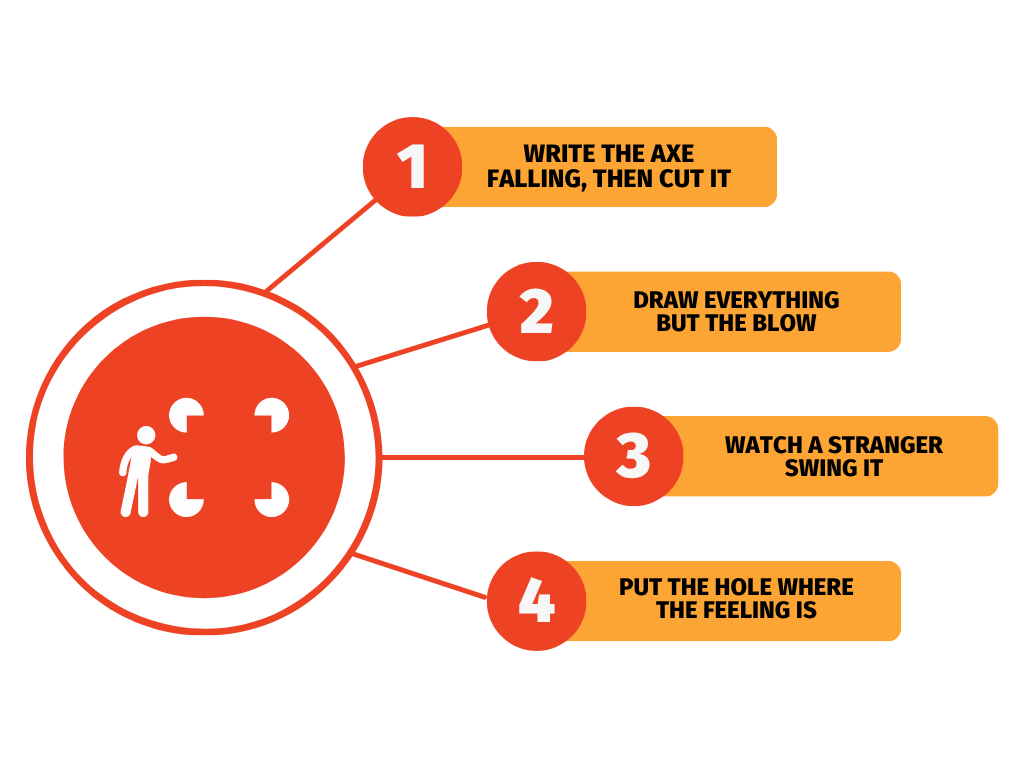
- Write the axe falling, then cut it. Draft the complete version first: the blow, the word, the resolving chord, the letter in the logo. Then remove the single element whose absence generates the most meaning. Hemingway could have removed the beer, the hills, the luggage; he removed the one word the whole story orbits. Cut only what you could have written in full. Hemingway warned in Death in the Afternoon in 1932 that a writer who omits things because he does not know them "only makes hollow places in his writing." The reader can feel the difference between a gap and a hollow. One has a shape pressing in from every side. The other has nothing pressing at all.
- Draw everything but the blow. The gap needs walls. In 1972, Paul Rand cut the IBM wordmark into eight horizontal bars with equal white space between them. The letters are half air, and nobody reads them as half air, because the bars fix the height, the width, the serifs, and the exact curve of the B. Rand had tried thirteen bars in 1967; they bled together in cheap reproduction, and the letters stopped closing. Eight held. Build the walls of your gap from things the audience already recognizes. A MAYA Principle reading applies here: the hole can be as strange as you like if the material around it is familiar enough to point.
- Watch a stranger swing it. Show the work to someone who has never seen it, without commentary. Ask them what happened. Three answers are possible. If they describe the blow you never drew, the gap is shaped correctly. If they ask what they were supposed to get, add a bar. If they describe the piece and never mention an absence at all, you showed too much; remove another bar and test again. Run this with three people, because a single reader's completion tells you about that reader. Three matching completions tell you about the shape.
- Put the hole where the feeling is. Facts are cheap to omit and cheap to supply; the reader fills a missing date without feeling anything. Hemingway hid a medical procedure, and readers reconstruct it in a sentence. He also hid the verdict on the relationship, and readers spend the whole story reconstructing that. The woman looks at the hills. The man carries the bags to the other side of the station. No sentence tells the reader the two of them are finished. The reader decides it, and a decision the reader made hurts more than a fact the author stated. When choosing what to cut, cut the emotional conclusion before the plot point.
Pro-tip: Test the gap under the conditions the audience will meet it, never under yours. Rand's thirteen bars closed on his drawing board and vanished on a photocopier. A cover that completes at full size on a monitor may read as a smudge as a thumbnail on a phone, and a chorus that resolves in the studio may lose its missing note in a car with the windows down. Shrink it, speed it up, play it once, and see whether the hole still has walls.
Exercise: Take a finished piece under two pages, or a single design, or a chorus. Find the sentence, panel, or bar that states the conclusion. Remove it. Show the amputated version to one person who has not seen the original and ask them to tell you how it ends. Compare their ending to the sentence you cut. Fifteen minutes. You finish with a measurement of how much of your conclusion the audience would have supplied unpaid.
Mistakes to Avoid
- Omitting what you never worked out. These are Hemingway's hollow places. A screenwriter who leaves the villain's motive vague because she never decided it produces a hole with no walls, and audiences file it under lazy. The gutter in McCloud's example works because McCloud could have drawn the blow; he chose the reader instead. Choose the reader. Do not conscript them to finish your homework.
- Mistaking obscurity for depth. A gap has a shape. Obscurity has none. If a viewer cannot tell what is missing, they cannot complete it, and closure never fires. The test in step three exists for this: the answer "what am I supposed to get?" means the piece is a locked door, and locked doors get walked past.
- Filling the hole yourself afterward. The caption explains the painting. The epilogue says the couple broke up. Each one takes the axe back out of the reader's hands and swings it for them, and a blow you watched someone else swing carries no weight. Once the gap is built, leave the room.
- Assuming every audience carries the same tune. Judge Doom's trick only works on toons because toons have heard "Shave and a Haircut" ten thousand times. Closure runs on pattern, and pattern comes from exposure, which is why the same gap fires for one audience and lies inert for another. A designer omitting a letterform relies on readers who have seen that alphabet all their lives. Before cutting, ask what the Mere Exposure Effect has already installed in your audience, and cut only from what is there.
- Cutting more because cutting worked. The first strategic omission strengthens a piece, so the maker removes a second, then a third, until the walls are gone and only holes remain. Hemingway cut one word from "Hills" and kept the beer, the bead curtain, the heavy bags, and the forty-minute wait, because those were the walls. Count your omissions. One load-bearing gap per piece is the working number. A second needs walls of its own, and a third usually means you are hiding.
What the Audience Adds
McCloud's charge against the reader had a second clause. Each of you committed the crime in your own style. The axe that fell in the gutter was a different axe for every reader: a different arc, a different sound. The maker builds one hole. The audience fills it a thousand ways.
Kanizsa's triangle shows the mechanism at its smallest scale. Nothing in the drawing specifies the brightness of the triangle. The viewer adds it, and the added brightness is the part they will fight for, because they saw it. Scale that up to a story and the pattern holds. "Hills Like White Elephants" ends with the woman saying she feels fine. For nearly a century critics have split on what she has decided. Some read the ending as consent. Some read it as the beginning of her leaving. Both camps are certain, and both camps built their certainty in a gap Hemingway left on purpose.
This is the trade the Law of Closure offers. The part of your work the audience completed is the part they will defend, because they made it. In exchange, you give up control over what that part contains. A maker who demands both ownership and control has to state everything, and everything stated is a Kanizsa triangle with its edges inked in: complete, and no longer glowing.
You can have an audience that takes orders or an audience that takes ownership. The gap gives you the second.
McCloud drew the axe going up. Somewhere in a book first printed in 1993, it is still going up, page after page, copy after copy, and it will never come down on its own. It comes down in the gutter, in the half second between one panel and the next, and it has come down every time the page has been turned, each time in a different hand.
None of those hands were his.