In the first days of March 1938, two twenty-three-year-olds in Cleveland signed a release and mailed it to New York. Jerry Siegel wrote the stories, and Joe Shuster drew them. The two had met at Glenville High School, and for five years they had reworked the same character and sent him to syndicate after syndicate: a strongman from a dying planet who wore a cape and a red S on his chest. The newspaper syndicates kept saying no. In January 1938, the McClure syndicate turned him down again, and Max Gaines, who worked there, forwarded the strips to Jack Liebowitz at Detective Comics. The company was launching a new magazine called
Action Comics, and it asked for thirteen pages.
Siegel and Shuster turned the strips into thirteen pages, and the paperwork followed. The release paid $130, ten dollars a page. In return, Detective Comics received the pages and the "exclusive right to the use of the characters and story, continuity and title," and the sale ran forever. The check, dated March 1 and signed by Liebowitz, also covered other stories the pair had sold the company and came to $412. It misspelled both their names. The signed release went back in the mail on March 3.
Action Comics #1 reached newsstands on April 18, 1938, for ten cents, with a man in a cape lifting a car over his head on the cover. In 1947, Siegel and Shuster sued to get their character back. A judge in Westchester County ruled the next year that Superman belonged to the publisher, and the two men settled for $94,013.16.
Shuster could redraw any panel of those thirteen pages in an afternoon. The two signatures on the release took a minute, and nothing either man did for the rest of his life undid them.
The Why
Shuster's panels and the release were two different kinds of decision. Jeff Bezos gave the two kinds their names in his 2015 letter to Amazon shareholders. Some decisions, he wrote, are one-way doors: once a person walks through, the room behind is gone. Most decisions are two-way doors. If the other side disappoints, "You can reopen the door and go back through." Bezos argued that the first kind deserves slow, careful deliberation and the second kind deserves speed.
One-Way and Two-Way Doors sort every decision by a single price: what it costs to undo. A working title and a pencil sketch open both ways. A tattoo and a contract that sells a right forever lock behind you. Between them sit doors that reopen for a price, such as a novel reissued with a new cover or a song re-recorded years later. The higher the price of the way back, the more care the door earns, and a door that reopens only at a price you would hate to pay counts as one-way.
Creative careers often run the two speeds backwards. A writer can spend a month on a title that stays changeable until the printer runs, then sign a publishing contract in an afternoon because the contract arrives with a deadline and a check. The craft decisions feel heavy because the work feels personal. The paperwork feels light because it arrives looking like routine. Siegel and Shuster had worked on their character for five years, and the release that sold him went back in the mail two days after the date on it. They had one buyer and five years of rejections behind them. The first one-way door in a career often arrives at that moment, when the maker has the least leverage and the most hope.
The How
One-Way and Two-Way Doors work in five moves, from sorting a decision to marking the day its door locks.
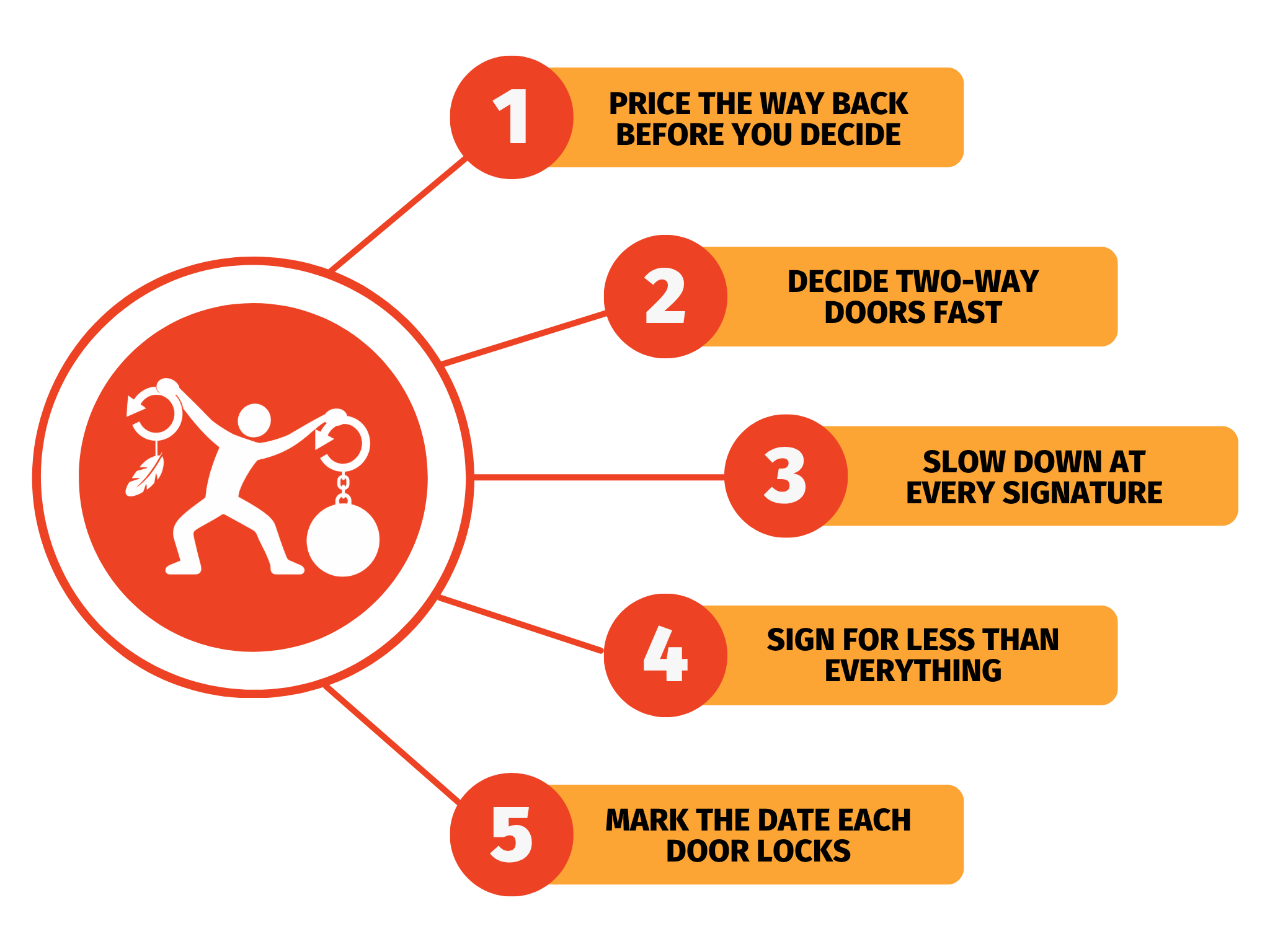
- Price the way back before you decide. Write down what undoing the decision would cost in money, time, and trust. A cost you could cover in a weekend marks a two-way door, and a cost you could never cover marks a one-way door. A Seattle band played its first shows as Mookie Blaylock, after the basketball player, and had to change the name before its first album came out in 1991. The musicians became Pearl Jam and called the album Ten, after Blaylock's jersey number. Before the record, the change cost them little. After Ten sold millions of copies, a second change would have cost them the name their audience knew.
- Decide two-way doors fast. Paul McCartney woke in his room at the Wimpole Street house of Jane Asher's family with a melody in his head and no words for it. He sang it with placeholder words, called it "Scrambled Eggs," and kept working on the tune. John Lennon later said the song was around for "months and months" before it was finished. McCartney wrote the real lyrics on a trip to Portugal in late May 1965, and he recorded "Yesterday" at Abbey Road on June 14, alone with an acoustic guitar. He spent months on the song and a moment on its name, because the name could change any day. Give a working title or an opening line ten minutes, pick one, and keep moving.
- Slow down at every signature. Most one-way doors in a creative career arrive as paper. Bill Watterson's first contract for Calvin and Hobbes, which debuted in 1985, gave Universal Press Syndicate control over merchandising. He refused to license his characters, and the fight with the company that distributed his strip dragged on for years. By 1991, he had a new contract that gave him control of the strip and all future licensing. Even with a hit strip behind him, he needed six years to win back what one signature had given away. Before you sign, read the rights clause aloud, circle every word that means forever, and wait one night.
- Sign for less than everything. A one-way door shrinks when the paper covers less. When George Lucas negotiated Star Wars with 20th Century Fox, the deal covered one film. Lucas kept the sequel rights, and Fox got only the first chance to make each sequel. Lucasfilm made the sequels, and in 2012 Disney paid about $4 billion for the company. Smaller signers can make smaller asks. A first-time author can ask for the rights to revert when the book goes out of print, and a freelance illustrator can license an image for two years and keep the copyright. Each clause leaves a way back.
- Mark the date each door locks. Many two-way doors turn one-way on a schedule. F. Scott Fitzgerald cycled through titles for his third novel, from Among the Ash Heaps and Millionaires to Trimalchio in West Egg, and settled on The Great Gatsby by cable in December 1924. On March 19, 1925, he cabled his editor, Maxwell Perkins: "Crazy about title Under the Red, White and Blue." He asked how long a change would delay the book. Perkins answered the same day that the novel had been advertised and sold for April 10, and a change would cost weeks. The door had locked when the orders came in. Next to every open decision, write the date it locks, such as the print date or the day of the announcement.
Exercise: Take a sheet of paper and list the next ten decisions your current project needs, from the font on the cover to the contract in your inbox. Beside each one, write what undoing it would cost and the date it locks. Circle every one-way door, along with any decision whose way back costs more than you would pay. Make every uncircled decision today, with ten minutes on a timer for each. For every circled one, schedule a wait of at least one night and name one person who will read it before you sign or announce anything. The exercise takes about twenty minutes, and you finish with a short list of decisions to make now and a shorter list to hold.
Tips and Tricks
- Decide in private, announce later. An announcement turns many two-way doors into one-way doors, because readers and partners start to plan around it. Settle the title before the cover reveal goes public.
- Talk to someone who signed before you. Before you sign with an agent, a publisher, or a label, ask one of their current clients which clause they would buy back if they could.
- Ask which clause the other side refuses to change. The clause someone guards hardest usually holds the one-way door.
- Write the undo email first. Draft the message you would send to reverse the decision. If it takes two lines and costs no one anything, walk through. If you cannot finish it, wait.
- Keep a door log. Write each decision, its door type, and its lock date in one notebook, and reread it every month to see which doors you misjudged.
Mistakes to Avoid
- Treating every choice as a one-way door. A novelist who rewrites the first chapter for a year has given a two-way door the care a contract deserves. The contract on the desk, the one door in the room that locks, gets whatever attention is left.
- Signing paperwork as routine. A deadline and a small check make a one-way door feel small. In 1971, Carolyn Davidson, a graphic design student at Portland State University, drew a logo for Phil Knight's shoe company and was paid $35. Knight said of it, "I don't love it, but it will grow on me." The company became Nike, and the logo became the Swoosh. Any share of what followed depended on Knight's goodwill, and in 1983 he gave her a gold Swoosh ring and 500 shares of Nike stock.
- Letting a two-way door rust shut. A cover you meant to revisit goes to print because the upload deadline passed. Delay turns open choices into defaults, and a default can lock as hard as any decision.
- Pricing the way back in money alone. An angry reply to a critic costs nothing to post and nothing to delete, and the screenshots outlast the deletion. Reputation and trust carry prices of their own.
- Reopening a two-way door every morning. A cheap way back tempts some makers to use it daily. A designer who swaps the logo font every week has turned a ten-minute decision into a weekly cost, and the brand never settles.
The Cost of an Open Door
In a study published in 2002, the Harvard psychologists Daniel Gilbert and Jane Ebert recruited undergraduates for a photography course. Each student shot a dozen pictures of life at Harvard, printed the two favorites in a darkroom session, kept one, and gave the other to the researchers for an archive. Half the students heard that the donated print would be mailed away at once. The other half heard they could swap prints when the experimenter called them four days later.
Over the following days, the students whose choice was final grew fonder of the print they kept. The students who could still swap ended up liking theirs less. Other students in the study, asked to predict their feelings, expected the option to make no difference. In a follow-up survey, about two out of three Harvard students said they would prefer the version with the swap.
The open door carries a price of its own. While a choice can still change, the mind keeps weighing it against the other option, and the weighing wears the choice down. The study points to a second rule for two-way doors: walk through fast, then close the door behind you. Pick the working title in ten minutes and call it final until the draft is done. A way back belongs on the doors that cost the most to undo, such as a contract that runs for decades. On a cheap door, a way back buys only more weighing.
One-Way and Two-Way Doors sort each decision by the price of the way back, and for Siegel and Shuster that price only rose. In April 2012, the check that misspelled their names sold at an online auction for $160,000. In November 2025, three brothers clearing out their late mother's house in northern California found a copy of Action Comics #1 in the attic, and Heritage Auctions sold it for $9.12 million. The comic had cost ten cents.
In 1975, with a Superman film in production, Siegel took their story to the press. Warner Bros. agreed to pay each man $20,000 a year and to print both names on every Superman story. To get their names back on the page, the two men signed one more paper, and it said once again that the publisher owned Superman.